
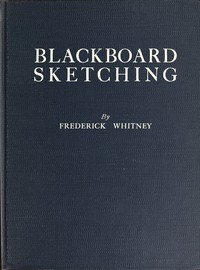
Blackboard Sketching by Frederick Whitney
So, what's this book actually about? Blackboard Sketching is exactly what the title promises. Published in 1909, it's a practical manual for teachers. Frederick Whitney believed that a teacher who could illustrate their lessons on the spot was a more effective teacher. The book is filled with specific, numbered instructions and simple illustrations. He breaks down how to draw everything from basic landscapes (trees, hills, cottages) to historical scenes and diagrams for subjects like geography and physiology.
The Story
There isn't a plot with characters in the traditional sense. The 'story' is the method itself. Whitney walks you through the process, starting with the tools (different kinds of chalk, erasers, how to prepare the board) and moving into techniques for shading, perspective, and quick sketching. Each lesson is a series of steps: 'First, draw this line. Second, add this curve. Third, shade this area lightly.' He provides templates for common educational images, believing that any teacher, regardless of natural talent, could learn to do this well. The narrative is one of empowerment through a very hands-on skill.
Why You Should Read It
You should read it for the historical window it opens. It’s a snapshot of classroom life before photocopiers, projectors, or the internet. The care and detail Whitney puts into something we now see as quaint is genuinely compelling. It reframes teaching as a performance art. There's also a quiet, meditative quality to following his precise instructions; it’s like a vintage puzzle for your brain. For anyone interested in education, art history, or just old how-to books, it’s a treasure. It reminds us that communication hasn't always been digital—sometimes, it was just chalk on slate, and doing it well mattered.
Final Verdict
This isn't for everyone. If you're looking for a sweeping novel, keep looking. But if you're a curious reader who loves primary sources, a teacher fascinated by the roots of your craft, a history buff interested in everyday skills, or an artist intrigued by obsolete forms, you'll find it surprisingly engaging. It’s a slim, focused volume that offers a clear and thoughtful look at a forgotten piece of educational culture. Perfect for a quiet afternoon when you want to learn something completely specific and off the beaten path.
Christopher Nguyen
1 month agoWithout a doubt, the depth of research presented here is truly commendable. Absolutely essential reading.
Emma Thomas
1 year agoRecommended.
Carol Miller
1 year agoThe layout is very easy on the eyes.

Donald Sanchez
10 months agoI had low expectations initially, however it manages to explain difficult concepts in plain English. This story will stay with me.