
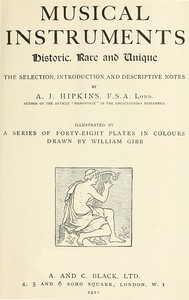
Musical Instruments, Historic, Rare and Unique by Alfred J. Hipkins
Published in the late 1800s, Musical Instruments, Historic, Rare and Unique is Alfred Hipkins's life's work. It's not a novel with a plot, but a guided tour through the evolution of sound. Hipkins organizes his journey by instrument family—strings, woodwinds, brass, and keyboards—but he focuses on the unusual specimens, the prototypes, and the glorious failures.
The Story
Think of it as a series of short stories, each about a different instrument. Hipkins introduces us to bizarre creations like the gargantuan octobass (a double bass so big you need a ladder to play it) and delicate, forgotten gems like the clavichord, where the strings are struck by tiny metal blades. He explains how the modern piano evolved from the harpsichord, and why certain shapes and materials fell out of favor. The "conflict" here is between innovation and tradition, between what worked and what was merely beautiful or strange. Hipkins acts as our expert witness, describing not just how these instruments look, but how they feel to play and, most importantly, how they sound.
Why You Should Read It
What makes this book special is Hipkins's voice. You can feel his genuine excitement. He writes about tuning a rare virginal or hearing a serpent (a wooden bass wind instrument that looks like a plumbing accident) with the joy of a discoverer. It transforms a technical subject into something personal. You're not just learning facts; you're sharing in his wonder. The detailed illustrations are stunning, but it's his descriptions of sound—metallic, reedy, breathy, thunderous—that bring these silent objects to life. It makes you listen to modern music with new ears.
Final Verdict
This book is perfect for curious music lovers, history buffs who enjoy material culture, and anyone who appreciates beautiful old books. It's not a quick read, but a slow, rewarding browse. If you've ever looked at an instrument in an antique shop or painting and thought, "What is that thing?" Hipkins has your answer. It's a timeless reminder that the music we know is just the tip of a very strange and wonderful iceberg.
Anthony Flores
1 year agoWithout a doubt, the atmosphere created is totally immersive. Truly inspiring.
Edward Garcia
2 months agoHaving read this twice, the arguments are well-supported by credible references. I couldn't put it down.





James Flores
1 year agoI came across this while browsing and the content flows smoothly from one chapter to the next. One of the best books I've read this year.