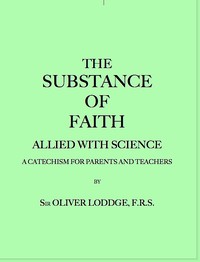
The Substance of Faith Allied with Science (6th Ed.) A Catechism for Parents and Teachers — Themes and Context
Edition facts
Sir Oliver Lodge, a physicist and principal of the University of Birmingham, wrote this catechism to help parents and teachers instruct children in religious faith without fear of future doubt from scientific inquiry. The preface frames the work as a response to the perceived conflict between old and new truths, which Lodge insists is only apparent. He warns against compulsory secularism in schools, arguing that sectarian disputes should not lead to the exclusion of any mention of a Supreme Being from education. The book aims to formulate the 'substance of religious faith in terms of Divine Immanence,' assimilating modern knowledge while preserving Christian fundamentals.
A Catechism for Educators, Not Theologians
Lodge explicitly addresses his work to 'parents and teachers,' not clergy or scholars. The preface notes the difficulty of instructing children 'without leaving them open to the assaults of doubt hereafter.' This practical orientation shapes the book's structure: a series of questions and answers designed to be used directly in teaching. Lodge avoids technical theological language, instead focusing on core beliefs that can be reconciled with scientific understanding. He expresses concern that teachers, 'deterred... by the difficulty of following out their ideals amid the turmoil of voices,' need clear guidance. The catechism thus serves as a tool for lay educators navigating the intersection of faith and science in early 20th-century Britain.
The Language of Reconciliation
Lodge's diction reveals his strategy for harmonizing science and religion. He uses terms like 'Divine Immanence' to describe God's presence in the natural world, a concept that allows for evolution and physical laws without supernatural intervention. In the preface, he speaks of 'the old truths and the new truths' as potentially conflicting only in appearance, emphasizing that 'internecine warfare between truths can be an appearance only.' This phrasing reflects his belief in a fundamental unity of knowledge. He also employs scientific vocabulary—such as 'assimilate' and 'results of existing knowledge'—to frame faith as compatible with empirical inquiry. The subtitle 'Allied with Science' underscores this partnership, not subordination.
Structure as Argument: The Question-and-Answer Form
The catechism format itself embodies Lodge's pedagogical method. By posing questions and providing concise answers, he models how teachers might address children's potential doubts. This structure also allows him to control the narrative, presenting faith as a series of logical propositions rather than mysteries. The preface indicates that the book was first published in February 1907 and went through six editions by April of the same year, suggesting a strong demand for such a resource. The rapid publication history implies that Lodge's approach resonated with educators seeking a non-sectarian, science-friendly religious instruction. The question-and-answer form also limits ambiguity, giving teachers ready-made responses to common queries.
A Warning Against Sectarianism and Secularism
Lodge devotes significant attention to the dangers of sectarian conflict. He argues that 'religious and educational disputes' would be 'stimulating to thought and fervour' if not for the risk of compulsory secularism. He fears that the nation might 'forbid, in the public part of the curriculum of elementary schools, not only any form of worship, but any mention of a Supreme Being.' This concern reflects the educational debates of early 1900s Britain, where the 1902 Education Act had intensified conflicts over religious instruction in state schools. Lodge's solution is not to advocate for a particular denomination but to find common ground in 'the fundamentals, or substance, of religious faith.' His emphasis on unity over division is a recurring theme.
Readers should approach this text as a historical document reflecting early 20th-century efforts to reconcile Christianity with modern science. Lodge's voice is that of a scientist who sees no inherent conflict between empirical evidence and spiritual belief. The catechism's brevity and directness make it accessible, but its arguments are rooted in the specific debates of its time—particularly the fear of secularism and the need for a non-sectarian religious education. For modern readers, it offers insight into how one prominent intellectual navigated the tensions between faith and reason, and how he sought to equip others to do the same.