About 395 minutes
The works of the Rev. John Wesley, Vol. 02 (of 32) — Context and Discussion
Theology
90,660 recorded words. 5 minutes difference from this book's estimate.
View Gutenberg source #63452
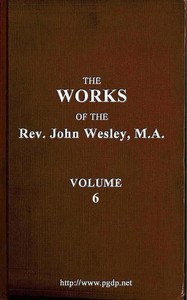
The catalog record for The works of the Rev. John Wesley, Vol. 06 (of 32) — Themes and Context provides practical reading context through 89,557 words, 6 hr 30 min estimated reading time, and 12 detected text sections.
The text analysis averages about 36.7 words per sentence, while the detected sections provide another way to judge how the source is divided.
Project Gutenberg metadata also associates the work with “Theology -- Early works to 1800,” connecting these edition facts with the source record’s subject description.
Explore this collection
These alternatives are selected using recorded categories and estimated reading time.
About 395 minutes
Theology
90,660 recorded words. 5 minutes difference from this book's estimate.
View Gutenberg source #63452About 396 minutes
Theology
91,032 recorded words. 6 minutes difference from this book's estimate.
View Gutenberg source #73261About 373 minutes
Theology
85,568 recorded words. 17 minutes difference from this book's estimate.
View Gutenberg source #73419Search stored excerpts and compare books → Choose by your preferences →
Choices use stored catalog measurements. Estimates vary with reading speed. A shared category is a catalog label, not a claim that two books have the same argument or literary quality.
Search reads excerpt text stored with this catalog and links to its associated Gutenberg record. The connection is stored in the site database; this tool does not recheck that every excerpt is word-for-word identical to that external record. Excerpt search does not cover every chapter and does not verify historical publication dates.
Catalog snapshot checked: 2026-09-26. Coverage: 94 public books, 94 available source excerpts.
Calculated from edition completeness, EPUB availability, text structure and catalogue metadata. Not a user rating.
Total of 100 points, scaled to a 2.5-5.0 range. Editions with an empty description or a missing EPUB file are not scored.
Public-domain source text
The source text is kept in the dedicated reader, separate from this catalogue record and its commentary.
This sixth volume of John Wesley's collected works opens not with his own sermons but with extended extracts from William Law's Serious Call to a Holy Life and later writings, followed by a substantial piece titled 'An Extract from the Case of Reason, or Natural Religion, Fairly and Fully Stated.' The arrangement is itself a statement: Wesley positions Law's devotional intensity as a foundation for the rational defense of Christianity that follows. The volume's structure—moving from practical piety to polemical theology—mirrors Wesley's conviction that heart and head must work together. Readers will notice Wesley's editorial presence in the asterisks marking passages he deemed most worthy of attention, a quiet but persistent guide through the text.
Wesley does not simply reprint Law's work; he extracts, condenses, and frames it. The table of contents lists chapters from Law's Serious Call—such as 'Recommending devotion at three o'clock' and 'Of the excellency and greatness of a devout spirit'—but these are selections, not the full text. Wesley's asterisks function as a primitive annotation system, directing the reader to what he considers most significant. This editorial layer transforms the volume into a dialogue: Law's voice is primary, but Wesley's priorities shape the conversation. The effect is akin to a guided reading, where the editor's judgments are visible but unobtrusive.
In the extract from the 'Case of Reason,' the author (likely Wesley or a source he endorses) employs a striking rhetorical device: a detailed hypothetical scenario of a bishop who impoverishes his family through excessive charity. The passage imagines the bishop's children becoming carpenters and tent-makers, echoing the trades of Jesus and Paul. The argument is not abstract but concrete, designed to force the reader to confront the implications of their own objections to charity. This method—building a vivid, almost novelistic example—recurs throughout the volume, grounding theological debate in imagined human situations. The prose shifts between tight logical argument and expansive illustrative narrative, a rhythm that keeps the reader engaged.
The volume's pace varies markedly between sections. Law's devotional prose moves slowly, with extended meditations on prayer and resignation. The 'Case of Reason' extract, by contrast, proceeds through numbered paragraphs and chapter divisions, each building a cumulative case against deism. Wesley's own contributions—if any—are absent from the excerpts, but his selection creates a deliberate alternation: the reader moves from Law's contemplative rhythms to the sharp, polemical cadences of rational theology. This juxtaposition suggests that Wesley saw no conflict between heartfelt piety and rigorous argument. The volume's pacing thus becomes a pedagogical tool, training the reader in both devotion and discernment.
Readers approaching this volume should attend to what Wesley chose to include—and what he left out. The extracts are not neutral reproductions but curated arguments. The asterisks, the hypothetical cases, the shifts in genre from devotional manual to rational defense all reflect Wesley's pastoral and polemical aims. This is a volume that rewards slow reading, with attention to the editorial choices that shape the theological conversation.
I found myself circling back to the editor’s choices—what he kept, what he pushed forward. That quiet discipline of deciding what matters reminded me of an old afternoon with The Christian Creed; or, What it is Blasphemy to Deny — Themes and Context, where the boundaries felt less like fences and more like resting places. Both books left me holding my own questions, gently.
A brief reflection can help important ideas stay with you longer.