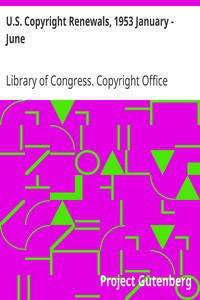
U.S. Copyright Renewals, 1953 January - June
Let's be clear from the start: this is not a novel. There's no plot in the traditional sense. 'U.S. Copyright Renewals, 1953 January - June' is exactly what the title says—a printed volume cataloging which copyrights were officially renewed during that six-month period. The 'story' it tells is one of bureaucratic process. For a copyright to be extended beyond its initial 28-year term, the owner had to file a renewal request. This book is the public record of those requests.
The Story
The 'characters' are the works themselves: books, songs, films, maps, and even advertisements originally copyrighted between 1925 and 1927. Each entry is a bare-bones fact: the title, the author or claimant, the original registration date, and the renewal number. There's no commentary, no review, no context. The 'action' is implied. A renewal suggests a work was still commercially or personally valuable nearly three decades later. The absence of a work from this list means its owner chose to let it go, allowing it to enter the public domain. The real narrative unfolds in the patterns you start to see—which genres saw lots of renewals, which publishers were meticulous about protecting their catalogs, and which once-popular names quietly disappeared.
Why You Should Read It
I love this book because it makes you an active detective. Reading it straight through would be madness. But dipping into it is a fascinating exercise. You start asking questions. Why did that obscure chemistry textbook get renewed, but that bestselling novel from 1926 didn't? You see the fingerprints of history. Renewals spike for works from 1927, likely because the owners had just lived through the Great Depression and World War II and were fiercely protecting their assets. It turns a dry legal requirement into a lens for understanding cultural endurance. It's a powerful reminder that what survives isn't always what's 'best'—it's what someone cared enough to keep.
Final Verdict
This is a niche book for a specific kind of curious mind. It's perfect for researchers, historians, writers looking for public domain material, or anyone who loves 'rabbit hole' non-fiction. If you enjoy sifting through archives, finding stories in data, or understanding the hidden mechanics of creative industries, you'll find this strangely captivating. It's not bedtime reading, but it is a unique primary source that offers a quiet, profound look at what we choose to keep.