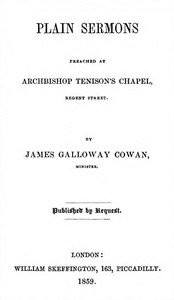
Plain Sermons, Preached at Archbishop Tenison's Chapel, Regent Street — Reading Companion

  5   1
Cowan, James Galloway, 1826-1875 Project Gutenberg 2021
Sermons, English; Church of England -- Sermons -- 19th century Readers of public-domain and historical texts
Project Gutenberg digital edition en

Edition facts

Words: 40,789
Reading time: 178 min
Text sections: 4
Cowan's 1859 sermons navigate tensions between worldly care and spiritual trust, individual conscience and pastoral authority, using scriptural exposition and practical reasoning to address Victorian churchgoers.
Share

Cowan opens his first sermon with a striking image from 2 Kings: the Samaritans who 'feared the Lord and served their own gods.' He calls this a 'mockery' and an 'impossible service,' setting up a central tension in these sermons—the conflict between divided loyalties and wholehearted devotion. Throughout the collection, Cowan returns to this pattern of contrast, opposing the 'natural man' to spiritual discernment, worldly anxiety to trust in Providence, and mere outward religion to inward transformation.

The Impossibility of Serving Two Masters

Cowan's first sermon, on Matthew 6:24-25, argues that attempting to serve both God and mammon is not merely forbidden but 'impossible.' He draws a sharp line between the commands, sanctions, and promises of Jehovah and those of false gods like Ashtaroth, Moloch, and Belial. This binary logic recurs throughout the volume: in Sermon X, the 'natural man' cannot receive spiritual things because they are 'foolishness unto him.' Cowan insists that spiritual discernment is a prerequisite for understanding, not a result of intellectual effort. The structure of these sermons often moves from a clear scriptural antithesis to practical application, urging listeners to examine their own divided hearts.

Pastoral Authority and the Limits of Confession

In Sermon VI on confession, Cowan navigates a delicate position. He detests 'Popish confession' and rejects any necessity of confessing every sin to a minister before pardon. Yet he strongly recommends that Christians 'knock oftener at your pastor’s door' for advice, comparing spiritual counsel to seeking 'physic for their souls' as they do for their bodies. He quotes the Bishop of Lincoln to support a limited, voluntary confession to a minister as an 'edifying practice.' Cowan warns against two extremes: treating clergy as mere 'Sunday lecturers' or exalting them as 'lords of men’s consciences.' The sermon models a via media, grounding pastoral authority in service rather than domination.

Forgiveness as Restoration, Not Mere Pardon

Sermon VII defines forgiveness as 'remission of the punishment due' and 'restoration of the offender to the position and privileges of the righteous.' Cowan emphasizes the 'ever fresh recurring need' of forgiveness, suggesting a continuous dependence on divine mercy rather than a one-time transaction. This theme of ongoing spiritual need connects to his earlier insistence on practical, week-day reliance on clergy. The sermons repeatedly stress that Christian life is a process—'forgetting those things which are behind and reaching forth' (Sermon IX)—not a static state. Cowan’s language is concrete: forgiveness restores the offender to a position, implying a relational and communal dimension often missing in abstract treatments.

Cowan’s sermons reward readers who attend to his careful distinctions and his habit of setting up oppositions only to qualify them. He is neither a rigid dogmatist nor a latitudinarian; his aim is to guide practical piety through reasoned scriptural exposition. The collection is best read slowly, sermon by sermon, noting how each builds on the tension between human limitation and divine provision. Readers interested in Victorian Anglican pastoral theology will find here a thoughtful, moderate voice.

Related eBooks