The course of creation — Text and Context
Edition facts
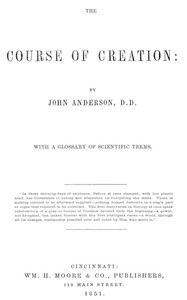
John Anderson's The Course of Creation (1851) opens with a defensive preface in which the author, a clergyman, justifies his geological pursuits as compatible with religious duty. He cites eminent divines like Buckland and Chalmers as precedents, and insists that studying rock formations leads him 'from nature up to nature's God.' The work then proceeds through systematic chapters on geological systems, from Silurian to Cretaceous, describing strata, fossils, and inferred ancient climates. Anderson's voice oscillates between devout wonder and technical exposition, often punctuated by rhetorical questions and exclamations.
A Defensive Preface and the Voice of Piety
The preface reveals Anderson's anxiety about the propriety of geology for a minister. He recounts questioning himself 'with severity at times' about his 'ardent love' of the science. His answer is that geological phenomena have 'uniformly led me from nature up to nature's God.' This personal, almost confessional tone contrasts with the more detached scientific prose of later chapters. He invokes a list of clerical geologists—Buckland, Conybeare, Sedgwick, Sumner, Smith, Fleming, Chalmers—as authorities who 'have given the sanction of their authority to tenets and views connected with the scheme of nature.' The preface thus establishes a rhetorical strategy: Anderson will present geological evidence as inherently religious, framing his work as a defense of faith through science.
Shifting Pace: From Descriptive Strata to Speculative Cosmology
The excerpt from Chapter V on the Cretaceous System shows Anderson at his most technical, describing 'alternating deposits of clay, lime, ironstone, coal, salt, gypsum' and inferring ancient lakes and estuaries. The pace is methodical, cataloging evidence. But the passage then accelerates into a speculative discussion of M. Poisson's theory that the entire solar system moves through space, bringing the Earth into varying temperatures. Anderson calls this 'the probable solution of all the changes of the past.' His language becomes almost poetic: the geologist 'rejoices to see his own earth taking part in the eternal music of the spheres.' Yet he immediately qualifies this as belonging 'rather to the poetry than to the philosophy of science.' This shift in register—from careful description to imaginative hypothesis and back—characterizes the book's rhythm.
Recurring Imagery and Rhetorical Questions
Anderson frequently employs rhetorical questions to engage the reader and advance his arguments. In the Cretaceous excerpt, he asks: 'May it be inferred that these two periods enjoyed a higher degree of temperature than has prevailed...?' Later, he poses a series of questions about the causes of climate change, dismissing cometary impacts and polar shifts before presenting Poisson's theory. This interrogative style creates a sense of dialogue, as if Anderson is thinking aloud. Recurring imagery includes 'the eternal music of the spheres,' 'the sweep of the comet,' and 'the miry pit' from which the geologist is lifted. Such metaphors tie the geological narrative to a cosmic, providential framework, reinforcing the book's central claim that the course of creation is both scientifically discernible and divinely ordained.
Readers approaching The Course of Creation should attend to the shifts in tone between the author's personal reflections and his systematic geology. Anderson's prose moves from defensive piety to technical description to speculative cosmology, often within a single chapter. The book rewards those who read for both its scientific content and its rhetorical strategies, as Anderson continually negotiates the relationship between empirical observation and religious conviction.