About 133 minutes
How to bring men to Christ — Reading Notes
Theology
30,560 recorded words. 14 minutes difference from this book's estimate.
View Gutenberg source #51931
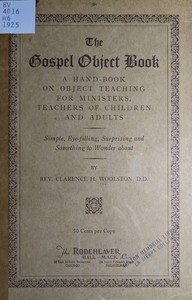
For The gospel object book — Themes and Context, the stored edition analysis reports 27,309 words, 1 hr 59 min estimated reading time, and 3 detected text sections.
The text analysis averages about 17.1 words per sentence, while the detected sections provide another way to judge how the source is divided.
Project Gutenberg metadata also associates the work with “Children's sermons,” connecting these edition facts with the source record’s subject description.
Explore this collection
These alternatives are selected using recorded categories and estimated reading time.
About 133 minutes
Theology
30,560 recorded words. 14 minutes difference from this book's estimate.
View Gutenberg source #51931About 139 minutes
Theology
31,920 recorded words. 20 minutes difference from this book's estimate.
View Gutenberg source #73954About 98 minutes
Theology
22,337 recorded words. 21 minutes difference from this book's estimate.
View Gutenberg source #39118Search stored excerpts and compare books → Choose by your preferences →
Choices use stored catalog measurements. Estimates vary with reading speed. A shared category is a catalog label, not a claim that two books have the same argument or literary quality.
Search reads excerpt text stored with this catalog and links to its associated Gutenberg record. The connection is stored in the site database; this tool does not recheck that every excerpt is word-for-word identical to that external record. Excerpt search does not cover every chapter and does not verify historical publication dates.
Catalog snapshot checked: 2026-09-26. Coverage: 94 public books, 94 available source excerpts.
Calculated from edition completeness, EPUB availability, text structure and catalogue metadata. Not a user rating.
Total of 100 points, scaled to a 2.5-5.0 range. Editions with an empty description or a missing EPUB file are not scored.
Public-domain source text
The source text is kept in the dedicated reader, separate from this catalogue record and its commentary.
In The Gospel Object Book, C. H. Woolston, a Baptist minister, presents a series of object lessons designed to teach Christian principles to children through tangible items. The book's preface sets a pedagogical foundation: Woolston asserts that children 'see 18 times more through the eye than they hear through the ear,' and that 80 percent of knowledge comes through sight. This emphasis on visual learning shapes the entire work, as each lesson revolves around a physical object—a piece of cloth, a coin, a seed—that the teacher displays while narrating a moral or biblical story.
The excerpts reveal a methodical approach: Woolston breaks down the Parable of the Prodigal Son into eight steps, each represented by a different colored rag (red for love, blue for discontent, gray for crooked money, etc.). The lessons are prescriptive, with specific instructions for the teacher to 'pick up' items in sequence, and they blend scriptural interpretation with practical moral advice, such as warning against the 'misuse of money' as a 'crooked step.'
Woolston's preface explicitly argues that children learn best through their eyes, a claim he supports with statistics: 'Eighty per cent of all the knowledge we receive from the cradle to the grave comes through the eye.' He contrasts this with the ineffectiveness of auditory instruction, noting that the burgeoning movie industry trains children 'to be good lookers.' This rationale underpins the entire book: each lesson is a performance where the teacher manipulates objects—rags, coins, seeds—while speaking. The Prodigal Son lesson, for instance, uses eight distinct cloth pieces, each color-coded to symbolize an aspect of the story (e.g., 'red stands for love,' 'blue ... for the dissatisfied heart'). The method is highly structured, with the teacher instructed to 'pick up' items in a fixed order, turning the lesson into a kind of scripted ritual. Woolston's confidence in this approach is evident when he claims that children who saw these lessons 'rehearse these lessons to me' years later, proving 'how deep and lasting is the impression made when truth enters the eye.'
Each object in Woolston's lessons carries a fixed moral meaning, often tied to a specific color or shape. In the Prodigal Son lesson, the 'gray cloth' represents 'the color of the silver coins' and is cut 'crooked' to signify 'a crooked step'—the misuse of money. Woolston extends this symbolism with a contemporary anecdote: a high school essay contest on 'If you had ten thousand dollars, what would you do with it?' where the winning boy said he would give it to his parents to save. This boy, Woolston asserts, 'would never be a prodigal because of the misuse of money.' The lesson thus moves from biblical narrative to direct moral application, warning against selfish spending and the allure of 'larger wages.' Similarly, 'gay ribbons tied together in various lengths' represent 'purchased friends' who abandon the prodigal when his money runs out. The objects are not merely illustrative but are treated as moral emblems, each with a pre-assigned virtue or vice.
Woolston writes in a direct, exhortatory style, often addressing the teacher with imperatives: 'Now pick up ...' His language is colloquial and vivid, as when he describes the prodigal's fall: 'Satan whispered here is joy, let loose; you are away from home; no one knows you; plunge in; and he did.' The tone is that of a seasoned preacher who has 'talked to over a million and a half of children,' blending folksy wisdom with scriptural authority. He frequently uses rhetorical questions and exclamations to engage his audience, as in the preface's lament that Peter 'forgot the Lambs.' The book's dedication to the 'wonderful children of the Cedar Falls (Iowa) Bible Conference' and its mention of 'the Glad Game of the Christian' suggest a playful yet earnest approach. Woolston also employs contrast: the prodigal's 'home garment' of fine cloth versus the 'rags' of his downfall, or the 'golden key' that unlocks a 'golden heart' for 'golden truth.' This repetitive, almost incantatory style reinforces the lessons' memorability.
The excerpts indicate that each lesson follows a consistent pattern: an opening scriptural reference, a list of required objects, and a step-by-step narration where the teacher displays each object while telling the story. The Prodigal Son lesson, for example, is divided into eight numbered steps, each introduced by 'Now pick up ...' and followed by an explanation of the object's symbolism. This format suggests the book was designed for live, interactive teaching, likely in Sunday school or children's church settings. Woolston's preface frames the work as a response to Jesus's command to 'Feed my Lambs,' and he positions object teaching as the most effective method. The lessons are self-contained, requiring only common materials like cloth scraps, coins, or seeds, making them accessible to any teacher. The book's subtitle, 'A hand-book on object teaching for ministers, teachers of children and adults,' confirms its practical purpose. However, the excerpts do not reveal the full range of lessons or whether they cover multiple parables or biblical stories.
Woolston's handbook is best approached as a period artifact of early 20th-century religious education, reflecting both the era's faith in visual media and its didactic moralism. Readers interested in the history of pedagogy or children's ministry will find a detailed example of object-based instruction, while those seeking scriptural commentary should note that the lessons prioritize moral application over exegesis. The book's value lies in its concrete demonstration of how one minister translated biblical stories into tangible, memorable experiences for children.
Flipping through Woolston's old object lessons, I paused at the coin in the child's palm, and it drifted, unbidden, to something far older—how those same small bronze pieces once paid passage for souls. The handbook teaches a parable; the other book wonders what Greeks truly believed lay beyond the river. Both, in their way, cup an invisible hope in open hands. Psyche: The Cult of Souls and Belief in Immortality among the Greeks — Inside the Classic felt like a quiet echo of that same reverence.
Capture what you thought, learned, and would like to remember.