About 1,138 minutes
Systematic Theology (Volume 3 of 3) — Text and Context
Theology
261,635 recorded words. 167 minutes difference from this book's estimate.
View Gutenberg source #45283
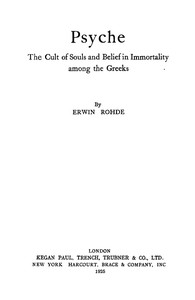
For Psyche: The Cult of Souls and Belief in Immortality among the Greeks — Inside the Classic, the stored edition analysis reports 300,041 words, 21 hr 45 min estimated reading time, and 78 detected text sections.
The text analysis averages about 15.1 words per sentence, while the detected sections provide another way to judge how the source is divided.
Project Gutenberg metadata also associates the work with “Greece -- Religion,” connecting these edition facts with the source record’s subject description.
Explore this collection
These alternatives are selected using recorded categories and estimated reading time.
About 1,138 minutes
Theology
261,635 recorded words. 167 minutes difference from this book's estimate.
View Gutenberg source #45283About 853 minutes
Theology
196,188 recorded words. 452 minutes difference from this book's estimate.
View Gutenberg source #73020About 708 minutes
Theology
162,804 recorded words. 597 minutes difference from this book's estimate.
View Gutenberg source #52232Search stored excerpts and compare books → Choose by your preferences →
Choices use stored catalog measurements. Estimates vary with reading speed. A shared category is a catalog label, not a claim that two books have the same argument or literary quality.
Search reads excerpt text stored with this catalog and links to its associated Gutenberg record. The connection is stored in the site database; this tool does not recheck that every excerpt is word-for-word identical to that external record. Excerpt search does not cover every chapter and does not verify historical publication dates.
Catalog snapshot checked: 2026-09-26. Coverage: 94 public books, 94 available source excerpts.
Calculated from edition completeness, EPUB availability, text structure and catalogue metadata. Not a user rating.
Total of 100 points, scaled to a 2.5-5.0 range. Editions with an empty description or a missing EPUB file are not scored.
Public-domain source text
The source text is kept in the dedicated reader, separate from this catalogue record and its commentary.
Erwin Rohde's Psyche opens with a striking methodological claim: Greek religion was a 'natural growth, not a special foundation,' lacking sacred books that might reveal its inner meaning. This premise shapes the entire work, as Rohde reconstructs beliefs about the soul and immortality from scattered evidence—funerary rites, epic poetry, mystery cults, and philosophical texts. The translator, W. B. Hillis, renders Rohde's dense German prose into English that preserves the author's analytical rigor, though the text retains a late-nineteenth-century scholarly voice, with frequent untranslated Greek terms and extensive footnotes.
Rohde begins with the Homeric poems, where the soul after death is a feeble, insubstantial shade. He argues that this conception reflects a deliberate suppression of older, more vivid beliefs about the dead. The evidence for these earlier ideas emerges in later cults: the worship of heroes, the rituals of the Eleusinian Mysteries, and the chthonic deities. Rohde's method is comparative, drawing on archaeological finds like defixiones—curse tablets buried with the dead—to show how ordinary Greeks sought to bind or compel spirits. The pace here is deliberate, as Rohde builds his case from textual and material sources, often pausing to weigh conflicting interpretations.
Part II marks a shift in tone and tempo. Rohde turns to the Thracian worship of Dionysos, which introduced ecstatic rites and the belief that the soul could be liberated from the body. The narrative accelerates as he traces how this foreign cult merged with Apolline religion, producing Orphic sects and Pythagorean asceticism. Rohde's language becomes more vivid when describing the enthousiasmos of the maenads and the magical practices of the kathartai—purifiers who claimed to control weather, heal disease, and summon ghosts. The footnotes swell with references to later sources like Porphyry and Iamblichus, creating a layered argument that moves between early evidence and its later elaborations.
The final section slows again, focusing on Plato's transformation of popular belief into philosophical doctrine. Rohde examines how Plato reinterprets the soul's immortality in dialogues like the Phaedo and Republic, blending Orphic myths with rational argument. The prose here is more measured, as Rohde dissects Plato's proofs and their debts to earlier traditions. He also surveys later Greek philosophy and popular religion, noting how magical practices persisted alongside philosophical speculation. The appendixes, which discuss topics like 'Consecration of persons struck by lightning' and 'Magical Exorcisms of the Dead,' reveal Rohde's interest in the margins of Greek religion—those practices that resisted rationalization.
Readers should approach Psyche as a work of historical reconstruction, not a systematic theology. Rohde's argument unfolds through accumulation of detail, and his footnotes are essential to following his evidence. The translation by W. B. Hillis is generally reliable, but those unfamiliar with Greek may find the untranslated terms challenging. A glossary of key terms—psyche, daimon, katharsis—would aid comprehension. For the most rewarding experience, read the appendixes alongside the main text; they contain some of Rohde's most intriguing material.
That rainy afternoon, Rohde’s account of shadowy Homeric souls lingered with me—how the Greeks imagined the dead as thin, murmuring breath. Later, almost by accident, I picked up The Garden of Eden: Stories from the first nine books of the Old Testament — Edition Insights, and found a different kind of beginning, less about leaving than about being shaped by what came before.
Use these questions to collect your thoughts before moving on.