About 708 minutes
A Bible Hand-Book — Reading Notes
Theology
162,804 recorded words. 145 minutes difference from this book's estimate.
View Gutenberg source #52232
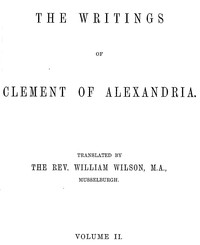
The source record for The writings of Clement of Alexandria, Vol. 2 (of 2) — Themes and Context measures this digital text at 196,188 words, 14 hr 13 min estimated reading time, and 141 detected text sections.
The text analysis averages about 20.0 words per sentence, while the detected sections provide another way to judge how the source is divided.
Project Gutenberg metadata also associates the work with “Theology -- Early works to 1800,” connecting these edition facts with the source record’s subject description.
Explore this collection
These alternatives are selected using recorded categories and estimated reading time.
About 708 minutes
Theology
162,804 recorded words. 145 minutes difference from this book's estimate.
View Gutenberg source #52232About 699 minutes
Theology
160,728 recorded words. 154 minutes difference from this book's estimate.
View Gutenberg source #50747About 692 minutes
Theology
158,967 recorded words. 161 minutes difference from this book's estimate.
View Gutenberg source #46975Search stored excerpts and compare books → Choose by your preferences →
Choices use stored catalog measurements. Estimates vary with reading speed. A shared category is a catalog label, not a claim that two books have the same argument or literary quality.
Search reads excerpt text stored with this catalog and links to its associated Gutenberg record. The connection is stored in the site database; this tool does not recheck that every excerpt is word-for-word identical to that external record. Excerpt search does not cover every chapter and does not verify historical publication dates.
Catalog snapshot checked: 2026-09-26. Coverage: 94 public books, 94 available source excerpts.
Calculated from edition completeness, EPUB availability, text structure and catalogue metadata. Not a user rating.
Total of 100 points, scaled to a 2.5-5.0 range. Editions with an empty description or a missing EPUB file are not scored.
Public-domain source text
The source text is kept in the dedicated reader, separate from this catalogue record and its commentary.
Clement of Alexandria’s second volume opens with a sustained argument that Greek poets and philosophers derived their insights from Hebrew Scripture. In the excerpts, he quotes Orpheus, Homer, and Menander to show that even pagan sources attest to a single, just God. This comparative method—citing classical lines and then matching them to biblical passages—defines the work’s rhetorical strategy. Readers should note how Clement treats Greek texts as corroborative evidence, not as independent authorities. The translator, William Wilson, renders the Greek quotations into English verse, preserving their poetic form while integrating them into Clement’s prose.
The first excerpt presents Clement’s method in miniature. He quotes Orpheus addressing God as “Deathless Immortal” and “Sire of our Mother,” then immediately links this to Isaiah and Moses. The phrase “μητροπάτωρ” (mother’s father) is singled out as a potential opening for heretical “emissions” of a divine consort—a warning that Clement will police theological language throughout. Readers should watch for how he balances appropriation with correction: Greek poetry is useful but must be read through a scriptural lens. The opening thus sets a pattern of citation, interpretation, and polemic that recurs across the volume.
In the middle excerpt, Clement assembles a chain of Greek voices—Phocylides, Philemon, Sophocles, Pindar, Hesiod, Solon—each presented as unwitting witnesses to monotheism. He juxtaposes their lines with scriptural parallels: Pindar’s “What is God? The All” is set against “Who hath known the mind of the Lord?” This section functions as a doxography, but with a polemical edge. Clement is not merely collecting parallels; he is arguing that the Greeks borrowed from Moses. The density of references can overwhelm a first-time reader. A useful approach is to track the biblical verse Clement pairs with each poet, noting how he prioritizes the scriptural source over the classical one.
Toward the end of the provided excerpts, Clement turns to the problem of evil. He quotes Archilochus—“O Zeus, thine is the power of heaven, and thou / Inflict’st on men things violent and wrong”—and Orpheus on God planting “cruel war” among mortals. Clement does not deny these lines; instead, he subsumes them under the biblical framework of divine sovereignty, citing Deuteronomy 32:39. This move reveals a key feature of his theology: God’s justice includes both blessing and calamity. Readers should note how Clement handles uncomfortable passages: he neither rejects them nor explains them away, but recontextualizes them within a scriptural narrative of God’s ultimate control.
The volume’s structure—a series of “Miscellanies” (Stromata)—means that arguments are not linear but associative. The excerpts show Clement moving from faith and knowledge (Book II) to marriage and continence (Book III), then to a defense of monotheism. The voice is that of a teacher addressing an audience familiar with both Greek literature and Christian scripture. Wilson’s translation, from the 1869 Ante-Nicene Christian Library edition, uses formal, nineteenth-century English. Readers should expect periodic Latin headings (e.g., “Basilidis Sententiam de Continentia et Nuptiis refutat”) that signal the original text’s scholarly apparatus. The work rewards readers who treat each section as a self-contained essay while watching for recurring themes.
Approach this volume as a dialogue between two literary traditions. Clement assumes his reader knows Homer and the prophets equally well. When a Greek line appears, ask: What biblical text is Clement thinking of? His method is not to dismiss pagan learning but to claim it for Christianity. The excerpts give a reliable sample of his technique: quotation, scriptural parallel, and doctrinal application. A first reading will benefit from focusing on these three steps rather than trying to master every reference.
Reading Clement weaving Homer into faith reminds me of evenings with my grandmother’s old Bible, margins filled with pencil notes. She loved The Second Book of Samuel for its raw honesty, how David’s grief felt like our own. This volume stirs that same hush—ancient words suddenly speaking to a quiet heart. The Expositor's Bible: The Second Book of Samuel — Reading Companion once gave me that exact feeling, like finding a familiar voice in a crowded room.
Use these questions to collect your thoughts before moving on.