About 699 minutes
The Expositor's Bible: The Book of the Twelve Prophets, Vol. 2 Commonly Called the Minor — Context and Discussion
Theology
160,728 recorded words. 9 minutes difference from this book's estimate.
View Gutenberg source #50747
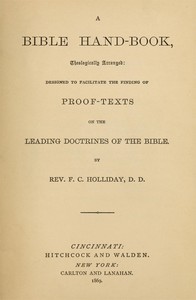
The catalog record for A Bible Hand-Book — Reading Notes provides practical reading context through 162,804 words, 11 hr 48 min estimated reading time, and 20 detected text sections.
The text analysis averages about 15.1 words per sentence, while the detected sections provide another way to judge how the source is divided.
Project Gutenberg metadata also associates the work with “Bible -- Indexes,” connecting these edition facts with the source record’s subject description.
Explore this collection
These alternatives are selected using recorded categories and estimated reading time.
About 699 minutes
Theology
160,728 recorded words. 9 minutes difference from this book's estimate.
View Gutenberg source #50747About 692 minutes
Theology
158,967 recorded words. 16 minutes difference from this book's estimate.
View Gutenberg source #46975About 618 minutes
Theology
141,948 recorded words. 90 minutes difference from this book's estimate.
View Gutenberg source #70648Search stored excerpts and compare books → Choose by your preferences →
Choices use stored catalog measurements. Estimates vary with reading speed. A shared category is a catalog label, not a claim that two books have the same argument or literary quality.
Search reads excerpt text stored with this catalog and links to its associated Gutenberg record. The connection is stored in the site database; this tool does not recheck that every excerpt is word-for-word identical to that external record. Excerpt search does not cover every chapter and does not verify historical publication dates.
Catalog snapshot checked: 2026-09-26. Coverage: 94 public books, 94 available source excerpts.
Calculated from edition completeness, EPUB availability, text structure and catalogue metadata. Not a user rating.
Total of 100 points, scaled to a 2.5-5.0 range. Editions with an empty description or a missing EPUB file are not scored.
Public-domain source text
The source text is kept in the dedicated reader, separate from this catalogue record and its commentary.
F. C. Holliday’s A Bible Hand-Book (1869) is not a commentary but a topical index of proof-texts, theologically arranged to support the leading doctrines of the Bible. The preface describes it as the product of “leisure moments” snatched from pastoral duties, and the structure reflects a practical, time-saving aim. The work is divided into books, chapters, and sections, with many subsections not listed in the table of contents—a feature that rewards patient browsing.
The language is consistently direct and doctrinal, with headings such as “Divinity of Christ Proven” and “The Sabbath must be kept as a Day of Rest from Secular Work.” Each section pairs a brief explanatory paragraph with a dense block of scriptural references, often from the King James Version. The voice is that of a minister-teacher, concise and authoritative, rarely pausing for rhetorical flourish.
The book’s organizing principle is theological, not canonical. Book I treats “Doctrines Relating to God,” moving from existence and attributes to the Trinity and the divinity of Christ. Within each chapter, numbered subpoints (e.g., “6. Omnipresence”) are followed by scriptural citations in a two-column layout. The table of contents lists only major headings; many finer divisions—such as the six proofs of omnipotence—are omitted, making the index less navigable than its title suggests.
Holliday’s method is evident in the section on the Sabbath: a short exposition of the fourth commandment is followed by a list of verses from Exodus, Jeremiah, and elsewhere. The exposition itself is a miniature sermon, using rhetorical questions (“Is it not reasonable…?”) and tripartite reasoning. This pattern—brief doctrinal statement, then proof-texts—recurs throughout, giving the work a consistent rhythm of assertion and evidence.
The expository paragraphs vary in length and intensity. In the Sabbath section, Holliday writes in measured, periodic sentences: “So this fourth commandment prescribes the time which God has been pleased to set apart for the more especial performance of acts of religious devotion and piety.” The pace is deliberate, building to a series of three reasons drawn from God’s example, the portion of time allotted, and the act of dedication.
Elsewhere, the voice becomes more urgent. In the preface, the author describes the work as “the result of the labor of such leisure moments as could be snatched from the more pressing duties of an active pastorate.” This personal note is rare; most of the book maintains a formal, homiletic tone. The pacing shifts between dense scriptural lists and these occasional explanatory passages, creating a pattern of compression and expansion that rewards careful reading.
Several structural features recur throughout the excerpts. First, the use of numbered subpoints within chapters—for example, the six proofs of omnipotence—creates a clear hierarchy of argument. Second, the two-column layout for scriptural references visually separates the author’s commentary from the biblical text. Third, the inclusion of multiple translations is not mentioned; the transcriber’s note states the source is “most probably the King James version,” and the excerpts confirm this.
The work also employs a distinctive system of cross-references: within the Sabbath section, Holliday cites Exodus 20, 23, 31, and 16, weaving them into a cumulative argument. This method of stacking verses from different books is typical of the proof-text genre. The result is a book that functions less as a linear read and more as a reference tool, where the same passage may appear under multiple doctrinal headings.
Readers approaching A Bible Hand-Book should treat it as a period reference work, not a modern concordance. Its theological arrangement reflects mid-19th-century Protestant orthodoxy, and its omissions—such as the lack of an index of scriptural passages—limit its use for topical study. However, the expository passages offer a window into Holliday’s pastoral voice, and the dense scriptural lists provide a snapshot of how proof-texts were marshaled in an era before digital search. For those interested in the history of biblical reference works, this hand-book is a compact example of a once-common genre.
Flipping through that old 1869 hand-book, I found its quiet, numbered proof-texts oddly comforting, a pastor’s orderly labor for weary students. It reminded me of a later, deeper reflection, Systematic Theology (Volume 3 of 3) — Text and Context, where the same patient threads are gathered again, not as lists, but as belonging to a single, larger fabric of thought.
Capture what you thought, learned, and would like to remember.