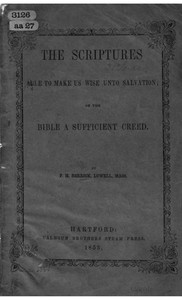
Francis H. Berrick’s 1853 tract opens with a sweeping claim: the Bible is a complete system, a “great fund of knowledge” that reveals creation, God’s character, and human history. The prose moves in a series of exclamatory tableaux—creation, the Fall, the promise of a ransom—punctuated by rhetorical questions and italicized emphasis. Berrick contrasts biblical wisdom with classical philosophers like Pythagoras and Socrates, positioning Scripture as superior in both philosophy and morality. The excerpt then shifts abruptly to a polemic against religious creeds, quoting an 1844 Advent Herald article that calls for “instant and final separation” from churches opposing the doctrine of Christ’s imminent return. This structural pivot from praise of Scripture to attack on human tradition defines the work’s argumentative rhythm.
Rhetorical Contrasts and Catalogues
Berrick builds his case through paired oppositions: the Bible versus human creeds, divine revelation versus human tradition, life versus death. A recurring device is the catalogue—a rapid series of biblical events listed in parallel clauses. For instance, he strings together “the wonderful conception of the Son of God—His birth—His miracles… His resurrection, His ascension, His intercession, His second coming, the judgment of the world, the resurrection of the dead, the translation of the saints, the destruction of the wicked, the establishment of the everlasting kingdom.” This breathless accumulation mimics the scope he claims for Scripture. Elsewhere, he contrasts “principles” with “men,” “measures” with “flesh and blood,” echoing Ephesians 6:12. Such structural pairings reinforce his central binary: the Bible as a unified, sufficient system versus fragmentary human creeds.
The Separatist Turn and Quoted Authority
Midway through the excerpt, Berrick inserts a lengthy block quotation from the Advent Herald (September 18, 1844), signed by “Br. J. V. H.” This quoted voice narrates the apostolic example of Paul separating from hardened unbelievers in Acts 19:8-9, then applies it directly: “It is DEATH to remain connected with those bodies that speak lightly of, or oppose, the coming of the Lord.” The quotation culminates in a call to “Come out from among them” (2 Corinthians 6:17-18). By embedding this separatist manifesto, Berrick aligns his own argument with a specific Adventist historical moment—the 1844 disappointment and its aftermath. The quoted text functions as both evidence and rallying cry, its capitalized urgency (“INSTANT and FINAL SEPARATION”) amplifying Berrick’s own polemic.
Creedal Oppression and Free Speech
Berrick’s second major argument targets creeds as instruments of suppression. He imagines a minister who embraces the “truth of the Lord’s speedy coming” and is silenced by church authorities: “he receives a line through the office, informing him he must desist, for it is contrary to the standards of the Church.” The language is concrete and bitter: “shear off the troublesome thinkers, and sing stagnant hallelujahs.” He then shifts to a hypothetical objection about church purity, answering with a sarcastic “Well, now, this looks very reason…” (the excerpt cuts off). The passage reveals Berrick’s rhetorical strategy: he personifies institutional power as a committee of “Elders, Bishops and Deacons” pledged to banish truth, while casting the individual preacher as a man of conscience. The emotional register moves from indignation to sardonic mimicry.
Movement Between Praise and Polemic
The tract’s structure oscillates between two modes: exalted celebration of Scripture and combative denunciation of human creeds. The opening paragraphs employ a liturgical cadence—“We look! We listen!! We hear the announcement”—with multiple exclamation points and a tricolon of verbs. This gives way to a more analytical tone when Berrick lists the Bible’s contents. But the separatist quotation reintroduces dramatic urgency, and the later sections on creedal oppression revert to a conversational, anecdotal style. This movement mirrors the work’s theological argument: the Bible’s sufficiency is not merely a doctrine but a call to action, requiring separation from corrupt institutions. Berrick’s shifts in voice—from doxology to testimony to satire—keep the reader engaged while reinforcing his central claim that Scripture alone must govern faith and practice.
Berrick’s tract is best read as a period piece of mid-nineteenth-century Adventist polemic, shaped by the 1844 disappointment and the subsequent need to define true ecclesiology. Its arguments rely on a stark binary between divine revelation and human tradition, a binary enforced by rhetorical contrasts and embedded quotations. Readers should note that the excerpts represent only the first half of the work; the full text likely develops the positive case for biblical sufficiency further. The tract’s value lies in its vivid snapshot of a movement struggling to articulate its identity against established churches.
I found myself thinking of that old tract—the one insisting Scripture alone suffices, no human creed needed—while later recalling how sermons once unfolded with similar quiet trust. Both carry that same unhurried certainty, a voice speaking as if to a friend beside a fire. It made me remember Sermons for the Day — Inside the Classic and its gentle cadence, so familiar it feels like remembering.