About 396 minutes
The works of the Rev. John Wesley, Vol. 07 (of 32) — Reading Notes
Theology
91,032 recorded words. 13 minutes difference from this book's estimate.
View Gutenberg source #73261
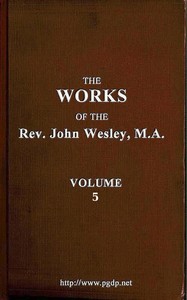
For The works of the Rev. John Wesley, Vol. 05 (of 32) — A Closer Reading, the stored edition analysis reports 93,958 words, 6 hr 49 min estimated reading time, and 18 detected text sections.
The text analysis averages about 33.6 words per sentence, while the detected sections provide another way to judge how the source is divided.
Project Gutenberg metadata also associates the work with “Theology -- Early works to 1800,” connecting these edition facts with the source record’s subject description.
Explore this collection
These alternatives are selected using recorded categories and estimated reading time.
About 396 minutes
Theology
91,032 recorded words. 13 minutes difference from this book's estimate.
View Gutenberg source #73261About 395 minutes
Theology
90,660 recorded words. 14 minutes difference from this book's estimate.
View Gutenberg source #63452About 425 minutes
Theology
97,561 recorded words. 16 minutes difference from this book's estimate.
View Gutenberg source #62126Search stored excerpts and compare books → Choose by your preferences →
Choices use stored catalog measurements. Estimates vary with reading speed. A shared category is a catalog label, not a claim that two books have the same argument or literary quality.
Search reads excerpt text stored with this catalog and links to its associated Gutenberg record. The connection is stored in the site database; this tool does not recheck that every excerpt is word-for-word identical to that external record. Excerpt search does not cover every chapter and does not verify historical publication dates.
Catalog snapshot checked: 2026-09-26. Coverage: 94 public books, 94 available source excerpts.
Calculated from edition completeness, EPUB availability, text structure and catalogue metadata. Not a user rating.
Total of 100 points, scaled to a 2.5-5.0 range. Editions with an empty description or a missing EPUB file are not scored.
Public-domain source text
The source text is kept in the dedicated reader, separate from this catalogue record and its commentary.
This fifth volume of John Wesley's collected works is built around two substantial extracts from William Law's Treatise on Christian Perfection and A Serious Call to a Holy Life. Wesley's editorial hand is visible in the selection and arrangement, which emphasizes practical holiness over abstract doctrine. The text moves between direct exhortation and vivid character sketches—such as the fretful Cælia, whose imagined slights make her 'more pale than ordinary'—to illustrate the spiritual disorders that religion corrects. Readers encounter a recurring structural pattern: a principle is stated, then exemplified through a fictional portrait, then defended against objections. This rhythm gives the volume a homiletic quality, as if each chapter were a miniature sermon.
Wesley's extracts from Law rely heavily on named characters to embody spiritual states. Flavia, Miranda, and Cælia are not mere illustrations but function as arguments: their habits of mind—imprudent spending, charitable use of wealth, self-absorbed melancholy—are presented as direct consequences of their relation to God. The portrait of Cælia is particularly sharp: she 'envies every beggar that she sees in health' and blames providence for her own disordered spirits. These sketches are not incidental; they carry the rhetorical weight of the treatise, showing that vice and virtue are not abstract but lived. The reader is invited to recognize these types in themselves or their acquaintances, making the moral teaching immediate and personal.
The volume's structure alternates between general principles and concrete cases. A chapter on the duty of devoting all to God's glory is followed by the contrasting portraits of Flavia and Miranda. This back-and-forth creates a dialectical movement: the reader is given a rule, then shown its violation and its fulfillment. The effect is cumulative; each new character adds a layer to the argument that happiness consists in complete holiness, not in a 'mixture of virtue and vice.' The excerpts also include direct rebuttals of objections, such as the claim that 'strict rules of piety must make our lives dull.' Law's response—that the more one extinguishes envy, the more happiness one gains—is typical of the volume's method: it meets skepticism with logical analogy and appeals to experience.
A persistent image cluster in these extracts is that of bodily health as a metaphor for spiritual condition. Cælia's 'tremblings and loss of appetite' are traced to her lack of Christian humility, which would 'sweeten' her blood. Law argues that it is as absurd to think moderate vice adds to happiness as to think 'the happiness of health consisted in being partly sick, and partly well.' This medical language—'disordered spirits,' 'reformed mind,' 'true ease'—frames sin as a disease and virtue as a cure. The imagery is not decorative; it structures the argument that religion is not a burden but a restoration to proper function. Wesley's selection preserves this organic metaphor, giving the volume a consistent sensory texture.
Wesley's role as editor is not passive. He marks passages he considers most worthy of attention with asterisks, a practice noted in the transcriber's preface. The volume also includes his own table of contents, which reorganizes Law's chapters into a sequence that moves from general principles to specific characters to broader exhortations. This editorial intervention shapes the reader's experience: the asterisks function as a guide to emphasis, while the arrangement creates a logical progression. Readers should note that the text preserves eighteenth-century spelling and punctuation, and that Wesley's own voice is present in the selection even when he does not comment directly. The volume is thus a collaboration between two theological minds, with Wesley curating Law for a Methodist audience.
Readers approaching this volume will benefit from attending to the asterisks Wesley placed in the margins—they signal passages he considered central. The fictional portraits reward close reading, as they condense complex arguments into memorable characters. Because the extracts are taken from longer works, some transitions may feel abrupt; the table of contents helps orient the reader. This is a volume best read slowly, allowing the interplay of principle and example to work as Wesley intended.
Reading Wesley’s careful handling of Law’s Flavia and Miranda, I remembered my grandmother’s worn copy of Five Minute Sermons, Volume I. For Low Masses on All Sundays of the Year by Priests of the Congregation of St. Paul — Text and Context, where the same quiet insistence on ordinary holiness felt like a hand on my shoulder. Both books never shouted; they simply waited.
Capture what you thought, learned, and would like to remember.