About 434 minutes
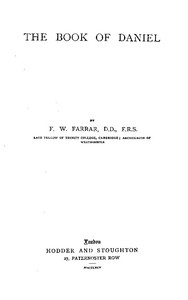
The Expositor's Bible: The Book of Daniel — Story, Setting & Ideas
Sermons Devotion
99,663 recorded words. 113 minutes difference from this book's estimate.
View Gutenberg source #44103

For Observations upon the Prophecies of Daniel, and the Apocalypse of St. John — Reading Companion, the stored edition analysis reports 73,631 words, 5 hr 21 min estimated reading time, and 9 detected text sections.
The text analysis averages about 30.5 words per sentence, while the detected sections provide another way to judge how the source is divided.
Project Gutenberg metadata also associates the work with “Bible. Daniel -- Prophecies,” connecting these edition facts with the source record’s subject description.
Explore this collection
These alternatives are selected using recorded categories and estimated reading time.
About 434 minutes
Sermons Devotion
99,663 recorded words. 113 minutes difference from this book's estimate.
View Gutenberg source #44103About 450 minutes
Sermons Devotion
103,383 recorded words. 129 minutes difference from this book's estimate.
View Gutenberg source #14485About 176 minutes
Sermons Devotion
40,413 recorded words. 145 minutes difference from this book's estimate.
View Gutenberg source #28103Search stored excerpts and compare books → Choose by your preferences →
Choices use stored catalog measurements. Estimates vary with reading speed. A shared category is a catalog label, not a claim that two books have the same argument or literary quality.
Search reads excerpt text stored with this catalog and links to its associated Gutenberg record. The connection is stored in the site database; this tool does not recheck that every excerpt is word-for-word identical to that external record. Excerpt search does not cover every chapter and does not verify historical publication dates.
Catalog snapshot checked: 2026-09-26. Coverage: 94 public books, 94 available source excerpts.
Calculated from edition completeness, EPUB availability, text structure and catalogue metadata. Not a user rating.
Total of 100 points, scaled to a 2.5-5.0 range. Editions with an empty description or a missing EPUB file are not scored.
Public-domain source text
The source text is kept in the dedicated reader, separate from this catalogue record and its commentary.
Isaac Newton's Observations upon the Prophecies of Daniel, and the Apocalypse of St. John applies the same rigorous analytical habits he brought to natural philosophy to the interpretation of biblical prophecy. The work opens with a detailed discussion of prophetic language, arguing that the prophets employed a consistent system of symbols—beasts, horns, metals, and numbers—that must be decoded by comparing scripture with scripture. Newton insists that prophecy is not a collection of obscure riddles but a coherent body of evidence, subject to the same rules of interpretation as any ancient text. His method is relentlessly textual: he cross-references Daniel and John with each other and with the Old Testament, seeking patterns that reveal a unified divine plan. The result is a dense, scholarly treatise that treats the Bible as a puzzle to be solved through careful observation and historical correlation.
Newton devotes an entire chapter to what he calls "the Prophetic Language," arguing that biblical prophecy operates through a fixed set of symbols. He observes that the same images—such as beasts representing kingdoms, horns representing kings, and metals representing ages—recur across Daniel and Revelation. For Newton, this consistency is not accidental but evidence of a divine author who speaks in a uniform idiom. He draws parallels between the visions of Daniel and the imagery of John, noting, for example, that the four beasts of Daniel correspond to the four metals of Nebuchadnezzar's dream. This systematic approach allows Newton to treat prophecy as a kind of code, one that can be broken by careful comparison of texts. He even extends the analysis to Christ's parables, showing how they too rely on everyday objects—harvests, lilies, fig trees—to convey spiritual truths. The result is a reading that emphasizes the Bible's internal coherence over allegorical speculation.
Newton's method is deeply historical. He attempts to match prophetic visions with specific empires and events, from the Babylonian captivity to the Roman Empire. In his analysis of Daniel's fourth beast, he identifies the ten horns as ten kingdoms that arose from the Roman Empire, and the "little horn" as a power that sought to change times and laws—a clear reference to the papacy, though Newton avoids naming it directly. He also calculates the "seventy weeks" of Daniel as a precise timeline leading to the birth and passion of Christ, using astronomical and historical data to fix dates. This chronological rigor reflects Newton's belief that prophecy is not merely symbolic but predictive, and that its fulfillment can be verified by historical evidence. However, the excerpts are incomplete, and Newton's full argument about the end times remains unclear; he may have intended to outline a future restoration of Israel or a final judgment, but the text as provided does not confirm this.
A central claim of Newton's work is that the prophecies of Daniel and the Apocalypse of John form a single, interconnected revelation. He argues that John's visions recapitulate and expand upon Daniel's, using the same symbolic language to describe the same historical processes. For instance, the beast with seven heads and ten horns in Revelation echoes Daniel's fourth beast, while the measuring of the temple in Revelation 11 parallels the prophecy of the sanctuary in Daniel 8. Newton also notes structural parallels: both books are divided into visions that progress from the Babylonian period to the end of history. This unity, he believes, confirms the divine origin of both texts and provides a key to interpreting obscure passages. By reading Daniel and John side by side, Newton aims to demonstrate that prophecy is a coherent system, not a collection of disjointed oracles. His approach is methodical, almost mathematical, treating each symbol as a variable that must be solved in relation to others.
Readers approaching Newton's Observations should be prepared for a dense, argumentative text that moves slowly through biblical passages. Newton assumes familiarity with the books of Daniel and Revelation, and he frequently cites Hebrew and Greek terms without translation. His tone is that of a scholar addressing other scholars, not a popular expositor. The work rewards patience: each chapter builds on the previous one, and the cumulative effect is a powerful demonstration of how a single interpretive method can illuminate two of the Bible's most difficult books. For those interested in the intersection of science and religion, or in the history of biblical criticism, this is a landmark text.
Newton’s careful tracing of Daniel’s symbols always reminded me of a patient archivist, and that same reverence for the text lives in A Plain Introduction to the Criticism of the New Testament, Vol. I. — Themes and Context, where every variant reading feels like a whispered correction between old friends. Two books, each guarding the other’s fragile certainties.
Use these questions to collect your thoughts before moving on.