About 450 minutes
Notes on the Apocalypse — Key Ideas to Explore
Sermons Devotion
103,383 recorded words. 16 minutes difference from this book's estimate.
View Gutenberg source #14485
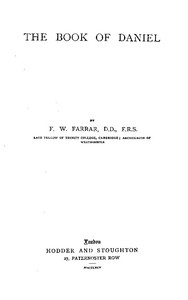
Before opening The Expositor's Bible: The Book of Daniel — Story, Setting & Ideas, the edition data offers a quick orientation: 99,663 words, 7 hr 14 min estimated reading time, and 17 detected text sections.
The text analysis averages about 17.9 words per sentence, while the detected sections provide another way to judge how the source is divided.
Project Gutenberg metadata also associates the work with “Bible. Daniel -- Commentaries,” connecting these edition facts with the source record’s subject description.
Explore this collection
These alternatives are selected using recorded categories and estimated reading time.
About 450 minutes
Sermons Devotion
103,383 recorded words. 16 minutes difference from this book's estimate.
View Gutenberg source #14485About 321 minutes
Sermons Devotion
73,631 recorded words. 113 minutes difference from this book's estimate.
View Gutenberg source #16878About 670 minutes
Sermons Devotion
154,000 recorded words. 236 minutes difference from this book's estimate.
View Gutenberg source #36548Search stored excerpts and compare books → Choose by your preferences →
Choices use stored catalog measurements. Estimates vary with reading speed. A shared category is a catalog label, not a claim that two books have the same argument or literary quality.
Search reads excerpt text stored with this catalog and links to its associated Gutenberg record. The connection is stored in the site database; this tool does not recheck that every excerpt is word-for-word identical to that external record. Excerpt search does not cover every chapter and does not verify historical publication dates.
Catalog snapshot checked: 2026-09-26. Coverage: 94 public books, 94 available source excerpts.
Calculated from edition completeness, EPUB availability, text structure and catalogue metadata. Not a user rating.
Total of 100 points, scaled to a 2.5-5.0 range. Editions with an empty description or a missing EPUB file are not scored.
Public-domain source text
The source text is kept in the dedicated reader, separate from this catalogue record and its commentary.
Farrar opens his commentary on Daniel by immediately confronting the book's linguistic duality: part Hebrew, part Aramaic. He treats this not as a mere curiosity but as a structural clue to the work's composition and purpose. Throughout, he moves between close reading of specific verses—such as the wordplay on weights in the handwriting episode—and broader assessments of the book's historical reliability, often concluding that the narratives function as moral and spiritual parables rather than precise records.
Farrar devotes sustained attention to the famous scene in Daniel 5, where a disembodied hand inscribes mysterious words on the palace wall. He notes that the Chaldean wise men could not even read the script, let alone interpret it. The rabbinic tradition, he reports, held that the words were written kionēdon, or pillar-wise, from top to bottom, making them appear as gibberish when read left to right. Farrar then unpacks the pun: the Aramaic words for weights—m'nah (mina), t'qilta (shekel), peres (half-mina)—also yield the verbs 'numbered,' 'weighed,' and 'divided.' This double meaning, he argues, is the secret that Daniel alone could unlock. The passage illustrates Farrar's method of combining philological detail with narrative analysis, showing how a single textual crux can reveal layers of meaning.
Farrar confronts head-on the historical puzzle of 'Darius the Mede,' a figure who appears in Daniel but is unknown outside the book. He systematically reviews proposed identifications—Cyaxares II, Astyages, the satrap Gobryas—and finds each wanting. The Cyropædia of Xenophon, he notes, is a romance, not history; Astyages would have been far older than sixty-two; and Gobryas was a governor, not an absolute monarch issuing decrees to all peoples. Farrar concludes that Darius the Mede likely originated from a literal reading of Isaiah and Jeremiah, rather than from any actual ruler. This section exemplifies his willingness to set aside apologetic harmonization in favor of critical analysis, treating the figure as a literary construct serving the book's theological message.
Farrar observes that the Belshazzar narrative is 'very swiftly brought to a conclusion' once the writing is interpreted. The king is slain that same night, and Darius takes the kingdom. This rapid denouement, he suggests, is deliberate: the story's essence has already been given in the wordplay and its interpretation. Farrar reads the episode as a 'moral and spiritual parable,' not a historical report. He draws attention to the irony in Belshazzar's name—'Bel, preserve the king!'—and notes that Bel and Nebo gave no help. The swift, almost formulaic ending, with its quotation of a poetic lament, reinforces the parabolic quality. Farrar's commentary thus treats narrative pacing as a clue to the book's genre and purpose.
In his introduction, Farrar surveys the book's language, unity, style, and standpoint. He notes that Daniel is written partly in Hebrew and partly in Aramaic, a feature that has long puzzled commentators. He addresses the question of unity—whether the book is the work of a single author or a composite—and leans toward the latter view, though he does not fully resolve the issue. His discussion of style emphasizes the book's 'general tone' and its standpoint, which he locates in the Maccabean period rather than the Babylonian exile. This critical orientation shapes his entire commentary: he reads Daniel as a product of its time, addressing the needs of a later generation through stories set in an earlier era. The introduction thus provides the framework for the detailed analyses that follow.
Farrar's commentary rewards readers who appreciate philological precision and historical skepticism. He does not shy from identifying contradictions or anachronisms, yet he treats the text with respect as a work of religious literature. Those approaching Daniel as prophecy will find Farrar's conclusions challenging; those interested in the book's composition and reception history will find a model of late-Victorian critical scholarship.
I remember sitting with Farrar’s Daniel, struck by how a story could feel both ancient and immediate—the writing on the wall as a quiet reckoning. That same hush came over me years later, reading the epistles, where judgment softens into invitation. Expositions of Holy Scripture Ephesians; Epistles of St. Peter and St. John — A Closer Reading held that same weight, like light through a stained window.
Answer a few questions and save a private reflection on this device.