About 330 minutes
Dead Men Tell Tales — Context and Discussion
Theology
75,736 recorded words. 6 minutes difference from this book's estimate.
View Gutenberg source #66366
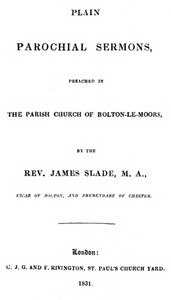
For Plain Parochial Sermons, preached in the Parish Church of Bolton-le-Moors — Reading Notes, the stored edition analysis reports 74,338 words, 5 hr 24 min estimated reading time, and 8 detected text sections.
The text analysis averages about 40.7 words per sentence, while the detected sections provide another way to judge how the source is divided.
Project Gutenberg metadata also associates the work with “Sermons, English -- 19th century,” connecting these edition facts with the source record’s subject description.
Explore this collection
These alternatives are selected using recorded categories and estimated reading time.
About 330 minutes
Theology
75,736 recorded words. 6 minutes difference from this book's estimate.
View Gutenberg source #66366About 313 minutes
Theology
71,890 recorded words. 11 minutes difference from this book's estimate.
View Gutenberg source #36572About 338 minutes
Theology
77,638 recorded words. 14 minutes difference from this book's estimate.
View Gutenberg source #60553Search stored excerpts and compare books → Choose by your preferences →
Choices use stored catalog measurements. Estimates vary with reading speed. A shared category is a catalog label, not a claim that two books have the same argument or literary quality.
Search reads excerpt text stored with this catalog and links to its associated Gutenberg record. The connection is stored in the site database; this tool does not recheck that every excerpt is word-for-word identical to that external record. Excerpt search does not cover every chapter and does not verify historical publication dates.
Catalog snapshot checked: 2026-09-26. Coverage: 94 public books, 94 available source excerpts.
Calculated from edition completeness, EPUB availability, text structure and catalogue metadata. Not a user rating.
Total of 100 points, scaled to a 2.5-5.0 range. Editions with an empty description or a missing EPUB file are not scored.
Public-domain source text
The source text is kept in the dedicated reader, separate from this catalogue record and its commentary.
James Slade's Plain Parochial Sermons opens with an advertisement expressing reluctance to publish, fearing that the pulpit's immediate impact would not survive in print. This self-deprecating frame sets the tone for a collection that consistently prioritizes direct moral instruction over rhetorical flourish. The sermons, preached between 1825 and 1831 at Bolton Parish Church and occasionally at Chester Cathedral, are organized around specific scriptural texts, each announced with a full verse citation and date. Slade's voice is measured and analytical, often dissecting a single concept—such as the distinction between outward reform and inward renewal—over several pages. His sentences are long and periodic, building arguments through accumulation of clauses, yet his vocabulary remains deliberately accessible, avoiding Latinate abstraction in favor of concrete moral terms like 'habit,' 'motive,' and 'conscience.'
Each sermon follows a consistent structural pattern: a scriptural text, a brief contextual introduction, then a sustained argument divided into numbered or logical points. In Sermon V, for instance, Slade takes Joseph's refusal of Potiphar's wife as his text and proceeds to examine the nature of temptation, the role of conscience, and the consequences of sin. The transitions are signaled by phrases like 'I proceed to consider' or 'Let us now examine,' giving the discourse a deliberate, almost legalistic progression. This structure reflects Slade's pedagogical aim: to lead his congregation step by step through a moral argument, ensuring no point is left obscure. The sermons are not emotional appeals but reasoned exhortations, built on the assumption that understanding precedes amendment.
Slade's narrative voice is consistently that of a pastor who fears his flock may be self-deceived. He repeatedly warns against 'the deceivableness of unrighteousness' and the danger of being 'too easily content with our spiritual condition.' His tone is not harsh but insistent, returning again and again to the gap between outward morality and inner transformation. In the extended passage on the old and new man, he argues that a man may correct 'vicious habits' without any 'essential or fundamental alteration of character,' driven by weariness or fear rather than genuine repentance. This psychological acuity—distinguishing between motives of expediency and motives of faith—gives the sermons a diagnostic quality, as if Slade is teaching his hearers to examine their own hearts with the same precision he applies to scripture.
The sermons move at a deliberate, cumulative pace. Slade builds arguments through repetition and expansion, often restating a point in different terms before advancing. In the section on the old man, he lists multiple scenarios—weariness of pursuits, fear of death, pressure of infirmities—each illustrating a false motive for reform. This technique creates a rhythm of assertion and example, giving weight to his conclusions. The pace is never hurried; Slade allows himself space to develop a single idea over several paragraphs, trusting that his congregation will follow. The effect is meditative rather than dramatic, suited to a congregation accustomed to sustained attention. Modern readers may find the pace slow, but it reflects a rhetorical strategy designed for oral delivery in a large parish church.
Readers approaching these sermons should expect a work of moral philosophy grounded in scripture, not a collection of stirring oratory. Slade's value lies in his careful dissection of motive and his refusal to settle for easy assurances. The sermons reward those who read slowly, attending to the distinctions he draws between appearance and reality. They offer a window into early nineteenth-century Anglican pastoral practice, where the pulpit served as a site for moral education as much as worship.
There’s something steadying in Slade’s plain sermons, how he traces motive back to habit, almost like watching a quiet tide. It reminded me of an old, sharper controversy from Lowestoft, one of those Observations on an Anonymous Pamphlet, Which Has Been Distributed in Lowestoft, and Its Neighbourhood, Entitled Reasons Why a Churchman May with Great Justice Refuse to — Themes and Context—both speak to the same inner weighing of conviction, even if the world has moved on.
Create a short personal record of your experience with this book.