About 342 minutes
Sermons by the Fathers of the Congregation of St. Paul the Apostle, Volume VI. — Reading Companion
Theology
78,496 recorded words. 4 minutes difference from this book's estimate.
View Gutenberg source #59991
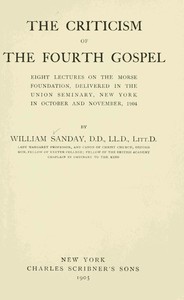
This digital edition of The Criticism of the Fourth Gospel Eight Lectures on the Morse Foundation, Delivered in the Union Seminary, New York in October and November 1904 — A Reader’s Guide is described by source-level measurements including 77,638 words, 5 hr 38 min estimated reading time, and 14 detected text sections.
The text analysis averages about 20.8 words per sentence, while the detected sections provide another way to judge how the source is divided.
Project Gutenberg metadata also associates the work with “Bible. John -- Criticism, interpretation, etc.,” connecting these edition facts with the source record’s subject description.
Explore this collection
These alternatives are selected using recorded categories and estimated reading time.
About 342 minutes
Theology
78,496 recorded words. 4 minutes difference from this book's estimate.
View Gutenberg source #59991About 346 minutes
Theology
79,360 recorded words. 8 minutes difference from this book's estimate.
View Gutenberg source #55988About 330 minutes
Theology
75,736 recorded words. 8 minutes difference from this book's estimate.
View Gutenberg source #66366Search stored excerpts and compare books → Choose by your preferences →
Choices use stored catalog measurements. Estimates vary with reading speed. A shared category is a catalog label, not a claim that two books have the same argument or literary quality.
Search reads excerpt text stored with this catalog and links to its associated Gutenberg record. The connection is stored in the site database; this tool does not recheck that every excerpt is word-for-word identical to that external record. Excerpt search does not cover every chapter and does not verify historical publication dates.
Catalog snapshot checked: 2026-09-26. Coverage: 94 public books, 94 available source excerpts.
Calculated from edition completeness, EPUB availability, text structure and catalogue metadata. Not a user rating.
Total of 100 points, scaled to a 2.5-5.0 range. Editions with an empty description or a missing EPUB file are not scored.
Public-domain source text
The source text is kept in the dedicated reader, separate from this catalogue record and its commentary.
Sanday opens his Morse Lectures by immediately grounding the discussion in the Gospel's incidental details—the small, seemingly insignificant points that belong to the narrative's framework rather than its salient features. He argues that these details, such as the people's attempt to make Jesus king by force (John 6:15) and the Sanhedrin's assumption that no prophet comes from Galilee, cohere beautifully with the historical setting of A.D. 28, not the later Christian beliefs of A.D. 90. This focus on verisimilitude becomes the central thread of the lectures.
The work is structured as eight lectures, delivered at Union Theological Seminary in 1904 and later repeated at Oxford. Sanday is candid about the controversial nature of his subject and the deep cleft dividing him from some critical scholars. He presents his case broadly and constructively, without extensive notes, aiming to state the case for the Gospel's authenticity through a balance of probabilities.
Sanday places great emphasis on what he calls the “framework, or setting of the narrative” rather than its more prominent theological claims. He collects a multitude of small points that, taken together, create a cumulative case for the Gospel's historical grounding. For instance, he notes that the popular expectation of a political messiah—evident in the crowd's attempt to make Jesus king—would have been an unnatural detail for a later writer to invent, since by A.D. 90 such ideas had entirely vanished. Similarly, the Sanhedrin's dismissal of Galilee as a source for prophets reflects a pre-70 Jewish perspective that a second-century Christian would have had little incentive to fabricate. Sanday argues that these details inspire a strong conviction that the author lived through the events described, though he concedes the theoretical possibility of a literary genius reconstructing the past.
Sanday does not dismiss the counterargument outright. He quotes Dr. Drummond, who reminds readers that the Gospel is unique in any case—whether true history or spiritual imagination—and that to assert what an unexampled literary genius could not have done is hazardous. Sanday acknowledges this possibility but frames the question as a balance of probabilities. He invokes Bishop Butler's maxim that probability is the very guide of life, suggesting that the simpler explanation—eyewitness testimony—is more plausible than invoking an unknown genius. This section reveals Sanday's methodological caution: he does not claim certainty but argues for the more natural reading of the evidence.
The lectures themselves move from the incidental details of the narrative (Lecture IV) to the character of the narrative (Lecture V), showing a deliberate structural progression. Sanday notes that he deliberately stopped short at points where more important issues arose, focusing instead on the small, less contestable points. This method reflects his belief that critical method should start with the least controversial evidence. The movement between scenes in the Gospel—from Galilee to Jerusalem, from public ministry to private discourse—is treated as a reflection of authentic memory rather than theological construction. Sanday's own lectures mirror this movement, building from concrete observations to broader conclusions.
Sanday identifies the burning point of the whole controversy as the question of the relationship between the theology of John and that of Paul. He criticizes critical writers for assuming without proof that John's theology is simply a development of Paul's, and that Paul's theology was entirely his own creation. Sanday insists that this ignores the role of the Mother Church and the life that gave it vitality. He admits that his own treatment of this issue is inadequate—merely a sketch for a possible answer. He predicts that the next great debate will be a fuller examination of the relations between the teaching of Christ, Paul, and John, with the question of the Fourth Gospel's authenticity as but an episode within it.
Sanday's lectures are best approached as a sustained argument from probability, grounded in the texture of the Gospel's narrative rather than in external proofs. Readers should attend to the way Sanday builds his case from small, concrete observations—the incidental details that he believes carry disproportionate weight. The work is not a comprehensive commentary but a focused polemic, and Sanday is refreshingly honest about its limitations. For those interested in the historical-critical debate over John's Gospel, these lectures offer a clear statement of the conservative position at the turn of the twentieth century, framed with scholarly caution and a willingness to engage opposing views.
Sanday’s gentle weighing of an eyewitness against a later literary genius always makes me feel the ache of not knowing. There’s something companionable about that uncertainty, the way it asks you to hold two truths at once. It reminds me of the quiet, unhurried margins I’ve kept in A Bible Hand-Book — Reading Notes, where the questions feel more like old friends than puzzles to solve.
A brief reflection can help important ideas stay with you longer.