About 342 minutes
Sermons by the Fathers of the Congregation of St. Paul the Apostle, Volume VI. — Reading Companion
Theology
78,496 recorded words. 4 minutes difference from this book's estimate.
View Gutenberg source #59991
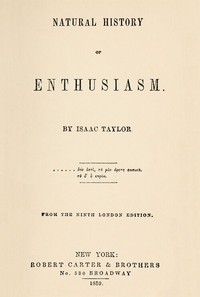
The source record for Natural History of Enthusiasm — A Reader’s Guide measures this digital text at 79,360 words, 5 hr 46 min estimated reading time, and 8 detected text sections.
The text analysis averages about 41.5 words per sentence, while the detected sections provide another way to judge how the source is divided.
Project Gutenberg metadata also associates the work with “Enthusiasm -- Religious aspects -- Christianity,” connecting these edition facts with the source record’s subject description.
Explore this collection
These alternatives are selected using recorded categories and estimated reading time.
About 342 minutes
Theology
78,496 recorded words. 4 minutes difference from this book's estimate.
View Gutenberg source #59991About 338 minutes
Theology
77,638 recorded words. 8 minutes difference from this book's estimate.
View Gutenberg source #60553About 355 minutes
Theology
81,635 recorded words. 9 minutes difference from this book's estimate.
View Gutenberg source #45475Search stored excerpts and compare books → Choose by your preferences →
Choices use stored catalog measurements. Estimates vary with reading speed. A shared category is a catalog label, not a claim that two books have the same argument or literary quality.
Search reads excerpt text stored with this catalog and links to its associated Gutenberg record. The connection is stored in the site database; this tool does not recheck that every excerpt is word-for-word identical to that external record. Excerpt search does not cover every chapter and does not verify historical publication dates.
Catalog snapshot checked: 2026-09-26. Coverage: 94 public books, 94 available source excerpts.
Calculated from edition completeness, EPUB availability, text structure and catalogue metadata. Not a user rating.
Total of 100 points, scaled to a 2.5-5.0 range. Editions with an empty description or a missing EPUB file are not scored.
Public-domain source text
The source text is kept in the dedicated reader, separate from this catalogue record and its commentary.
Isaac Taylor opens Natural History of Enthusiasm by directly confronting a terminological difficulty: the word 'enthusiasm' must be wrested from those who misuse it, yet no single term can perfectly capture the abstraction of 'fictitious piety.' He proposes to depict 'FICTITIOUS SENTIMENT in matters of religion' without constructing a cumbersome multi-syllabic definition for every page. This methodological candor—acknowledging the imprecision of language while forging ahead—sets the tone for a work that is at once analytical and pastoral.
The excerpts available for this edition are drawn from the opening advertisement and a later section on Christian ministry. The advertisement, written in 1829, expresses a hope for 'a bright era of renovation' in the church, but warns that such seasons historically attract a specious piety. Taylor's task is to describe that illusion, not to predict its arrival.
Taylor devotes his advertisement to explaining his choice of 'enthusiasm' as a label. He argues that when discussing mental phenomena, the best one can do is select a familiar word that 'approximates more nearly than any other to the abstraction spoken of.' To demand more—a fully renovated science of mind and a reformed language—would be to prevent the discussion from starting. This pragmatic approach reveals Taylor's awareness of the limits of ethical writing. He does not claim to have solved the problem of definition, only to have made a workable choice. The reader should note that Taylor uses 'enthusiasm' not in its modern sense of eager excitement, but as a technical term for a counterfeit religious sentiment that mimics genuine piety. The advertisement explicitly pairs it with 'FICTITIOUS PIETY' and 'FICTITIOUS SENTIMENT,' capitalizing the phrases for emphasis.
In the later excerpt, Taylor turns to the Christian ministry as a test case for distinguishing true from false devotion. He describes the minister as one who is 'baptized with the baptism wherewith his Lord was baptized,' taking on a vicarious responsibility for others' welfare. The language is stark: the minister 'has freely undergone a suretyship' and must be willing 'to do and to bear the utmost of which humanity is capable.' Taylor grounds this in the example of Christ and the apostles, quoting Paul's litany of hardships—'hunger, and thirst, and are naked, and are buffeted, and have no certain dwelling place.' The point is that genuine service entails suffering, not exemption from it. Taylor insists that the conditions of service have not been relaxed; the path of Christian beneficence remains 'more beset than the common walks of life with disheartening reverses.'
Taylor's prose becomes almost allegorical when he lists the trials that await the faithful minister: 'the frustration of his plans by the obstinate folly of those whom he would fain serve, the apathy, the remissness, or the sinister oppositions of professed coadjutors, the dangerous hostility of profligate power, and worse than all, the secret misgivings of an exhausted spirit.' These, he writes, are 'the furniture of the theatre on which the favor of Heaven is to be won.' The theatrical metaphor is striking: the minister's life is a stage, and the props are instruments of torture held by 'Disappointment.' This passage suggests that Taylor sees enthusiasm as a temptation precisely because it promises to bypass such suffering—to make the minister feel like 'the darlings of Heaven.' The apostles, by contrast, possessed supernatural power for attestation but none for alleviating their own distresses.
Because the excerpts are limited to the opening and a single later section, the full arc of Taylor's argument remains unseen. The advertisement promises a survey of enthusiasm 'under its principal forms,' but the available text does not reveal how many forms he treats or what they are. The reader should be alert to the possibility that Taylor's method is cumulative: he may define the term, then apply it to various manifestations of religious feeling—perhaps in revivalism, mysticism, or asceticism. The later excerpt's focus on ministry suggests that Taylor is concerned with practical consequences, not just abstract theory. When reading the complete work, note how Taylor transitions from definition to application, and whether he maintains the same caution about language throughout.
Taylor's Natural History of Enthusiasm rewards a reader who attends to his careful distinctions and his willingness to name the costs of genuine faith. The excerpts hint at a work that is both a diagnostic tool and a pastoral warning. As you read, track how Taylor uses biblical examples not as proof texts but as patterns of experience. His voice is that of a moralist who trusts his reader to follow a sustained argument—one that begins with a word and ends with a way of life.
That rainy afternoon, I kept returning to Isaac Taylor’s careful sorting of true piety from its masks, the way he weighed fervor against fruit. It felt like listening to someone breathe slowly. Later, thumbing the shelf, I landed on Dead Men Tell Tales — Context and Discussion, and found the same quiet patience—how stories surface only when we stop demanding they speak.
A brief reflection can help important ideas stay with you longer.