About 254 minutes
The World's Great Sermons, Volume 05: Guthrie to Mozley — Reading Companion
Theology
58,259 recorded words. 12 minutes difference from this book's estimate.
View Gutenberg source #44420
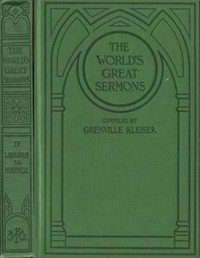
The catalog record for The World's Great Sermons, Volume 04: L. Beecher to Bushnell — Reading Companion provides practical reading context through 60,963 words, 4 hr 26 min estimated reading time, and 6 detected text sections.
The text analysis averages about 26.7 words per sentence, while the detected sections provide another way to judge how the source is divided.
Project Gutenberg metadata also associates the work with “Sermons,” connecting these edition facts with the source record’s subject description.
Explore this collection
These alternatives are selected using recorded categories and estimated reading time.
About 254 minutes
Theology
58,259 recorded words. 12 minutes difference from this book's estimate.
View Gutenberg source #44420About 253 minutes
Theology
58,144 recorded words. 13 minutes difference from this book's estimate.
View Gutenberg source #44441About 252 minutes
Theology
57,756 recorded words. 14 minutes difference from this book's estimate.
View Gutenberg source #44439Search stored excerpts and compare books → Choose by your preferences →
Choices use stored catalog measurements. Estimates vary with reading speed. A shared category is a catalog label, not a claim that two books have the same argument or literary quality.
Search reads excerpt text stored with this catalog and links to its associated Gutenberg record. The connection is stored in the site database; this tool does not recheck that every excerpt is word-for-word identical to that external record. Excerpt search does not cover every chapter and does not verify historical publication dates.
Catalog snapshot checked: 2026-09-26. Coverage: 94 public books, 94 available source excerpts.
Calculated from edition completeness, EPUB availability, text structure and catalogue metadata. Not a user rating.
Total of 100 points, scaled to a 2.5-5.0 range. Editions with an empty description or a missing EPUB file are not scored.
Public-domain source text
The source text is kept in the dedicated reader, separate from this catalogue record and its commentary.
The fourth volume of Grenville Kleiser's ten-part series presents sermons from Lyman Beecher (1775–1863) through Horace Bushnell (1802–1876), a span that moves from early American revivalism to mid-nineteenth-century theological reflection. The excerpts show that these are not simple exhortations but carefully reasoned arguments: Beecher's opening sermon on the Lord's Prayer treats "Thy will be done" as a formal surrender of earthly dominion, while John Henry Newman's contribution examines Old Testament phrases like "Thou shalt surely die" to argue that death means separation from God. The collection's title promises "great sermons," but the texts themselves often read more like theological essays than spoken addresses.
Grenville Kleiser, identified as a former member of the Yale Divinity School faculty, compiled these sermons with assistance from "many of the foremost living preachers and other theologians." The volume includes a brief biographical note for each preacher, but the excerpts show no editorial commentary within the sermons themselves. The selection ranges from Lyman Beecher (born 1775) to Horace Bushnell (died 1876), covering ten preachers in roughly chronological order. The contents page lists sermons with titles such as "The Government of God Desirable" and "The Expulsive Power of a New Affection," suggesting that Kleiser prioritized doctrinal or philosophical topics over occasional or topical preaching. The volume is part of a ten-volume set, implying a comprehensive survey, but the excerpts do not reveal the criteria for inclusion or exclusion.
Several sermons in the excerpts proceed by parsing specific biblical passages in detail. Newman's sermon, for instance, builds its case from Hezekiah's prayer in Isaiah and Ezekiel's repeated phrases "He shall surely live" and "He shall surely die." Newman argues that these expressions refer not to physical lifespan but to one's relationship with God: "to be dead and to be without God are precisely the same thing." He draws a distinction between David, who was forgiven and remained God's servant despite punishment, and Saul, who lost his kingdom and life but is not said to have received the sentence "Thou shalt surely die." This method of argument—treating individual verses as clues to a hidden spiritual reality—characterizes the volume's approach to theology.
A recurring theme in the excerpts is the redefinition of death as alienation from God rather than biological cessation. Newman explicitly states that "the grave cannot praise Thee" from Hezekiah's prayer expresses "the feeling that God is not the God of the dead." He connects this to the banishment from Eden, which he interprets as a banishment from God's presence: "in the day that Adam sinned he died; for he was cast out of Eden immediately." The sermon then applies this to contemporary listeners, asking whether many live "unconscious of His existence" and therefore "must be according to the Scripture, reckoned among the dead." This move from exegesis to application is typical of the volume's rhetorical strategy, though the excerpts do not show how other preachers in the collection handle the same theme.
Readers approaching this volume should expect dense, text-centered arguments rather than narrative or illustrative preaching. The excerpts suggest that Kleiser selected sermons that reward careful rereading, particularly for their handling of scriptural language. Because the volume contains only ten sermons across 266 estimated reading minutes, each text can be studied in some depth. The biographical notes provide context, but the sermons themselves do not reference contemporary events, leaving their historical setting largely implicit.
I remember sitting in my grandfather’s study, the weight of these old sermons in my hands, and thinking how strange it was that death could feel less like an ending and more like a forgetting. That same ache returned later with The Potter and the Clay—that quiet sense of being shaped rather than shattered. Both books left me sitting still, listening to the room’s silence. The Potter and the Clay — A Reader’s Guide felt like a hand on my shoulder, not a lesson.
Build a private reading journal entry for this title.