About 252 minutes
The World's Great Sermons, Volume 06: H. W. Beecher to Punshon — Context and Discussion
Theology
57,756 recorded words. 1 minutes difference from this book's estimate.
View Gutenberg source #44439
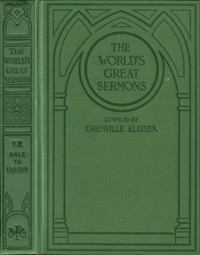
The catalog record for The World's Great Sermons, Volume 07: Hale to Farrar — Text and Context provides practical reading context through 58,144 words, 4 hr 13 min estimated reading time, and 5 detected text sections.
The text analysis averages about 24.8 words per sentence, while the detected sections provide another way to judge how the source is divided.
Project Gutenberg metadata also associates the work with “Sermons,” connecting these edition facts with the source record’s subject description.
Explore this collection
These alternatives are selected using recorded categories and estimated reading time.
About 252 minutes
Theology
57,756 recorded words. 1 minutes difference from this book's estimate.
View Gutenberg source #44439About 254 minutes
Theology
58,259 recorded words. 1 minutes difference from this book's estimate.
View Gutenberg source #44420About 251 minutes
Theology
57,549 recorded words. 2 minutes difference from this book's estimate.
View Gutenberg source #44053Search stored excerpts and compare books → Choose by your preferences →
Choices use stored catalog measurements. Estimates vary with reading speed. A shared category is a catalog label, not a claim that two books have the same argument or literary quality.
Search reads excerpt text stored with this catalog and links to its associated Gutenberg record. The connection is stored in the site database; this tool does not recheck that every excerpt is word-for-word identical to that external record. Excerpt search does not cover every chapter and does not verify historical publication dates.
Catalog snapshot checked: 2026-09-26. Coverage: 94 public books, 94 available source excerpts.
Calculated from edition completeness, EPUB availability, text structure and catalogue metadata. Not a user rating.
Total of 100 points, scaled to a 2.5-5.0 range. Editions with an empty description or a missing EPUB file are not scored.
Public-domain source text
The source text is kept in the dedicated reader, separate from this catalogue record and its commentary.
Edward Everett Hale opens his sermon 'The Colonization of the Desert' with a striking personal account: 'In ten weeks' time I have crossed from one ocean to the other.' This immediate grounding in travel—across states, climates, and races—anchors his exposition of Genesis 1:31 in lived experience. The sermon thus begins not with doctrine but with a concrete journey, inviting the reader to see the land as part of God's 'very good' creation.
Hale's opening paragraph is a catalogue of movement: crossing mountains, valleys, and oceans; meeting white, black, red, and Chinese people; experiencing palm shade and deep snow. This is not mere scene-setting but a rhetorical device that makes the Genesis text immediate. He does not argue abstractly about creation's goodness; he shows it through the variety he has witnessed. The reader is drawn into a specific American landscape of the 1880s, where the 'colonization of the desert' is both literal and spiritual. Hale's method suggests that the preacher's own experience can serve as a lens for scripture.
In 'The Miraculous Stilling of the Storm,' Magee likely focuses on the Gospel account with careful attention to narrative detail. The excerpt is not provided, but the title and context suggest a close reading of the storm story. Magee, an Irish Anglican archbishop, was known for expository preaching that unpacked the dramatic elements of biblical scenes. Readers can expect him to treat the storm not merely as a miracle but as a scene with psychological and theological layers—perhaps emphasizing the disciples' fear and Jesus' authority. This contrasts with Hale's expansive, travel-based approach.
Henry Parry Liddon's 'Influences of the Holy Spirit' includes a lengthy passage defending the Bible's diversity. He imagines critics who would 'draw up their lists of proscription' against various books—'the so-called pessimism of Ecclesiastes,' 'the alleged secularism of Esther.' Liddon argues that the Bible, like nature, has 'exhaustless variety' and that the Spirit 'bloweth where it listeth.' This is a meta-commentary on how to read scripture: not by imposing uniformity but by trusting that even difficult passages are 'integral parts of a living whole.' His rhetorical flourish—listing objections—shows his engagement with contemporary skepticism.
Frederic Farrar's 'Work in the Groaning Creation' takes Romans 8 as its text, likely exploring Paul's image of creation groaning for redemption. The title suggests an ecological or cosmic dimension, unusual for its time. Farrar, a noted preacher and novelist, often combined literary sensitivity with theological depth. Readers can anticipate a sermon that moves from the physical world's suffering to the hope of renewal, perhaps linking the 'groaning' to human labor and divine purpose. This closing sermon in the volume offers a broad, almost evolutionary perspective, contrasting with the more personal openings of Hale and Magee.
Reading these sermons sequentially reveals a spectrum of 19th-century homiletic styles: from Hale's autobiographical journey to Liddon's intellectual defense of scripture's complexity. The volume rewards attention to how each preacher selects and frames a biblical text. Rather than seeking a unified theme, observe the distinct rhetorical moves—travel narrative, dramatic retelling, apologetic argument, cosmic vision—that make each sermon a product of its author's voice and era.
That rainy afternoon, Farrar’s cosmic reading of Romans left me restless—his heavens felt vast but somehow hollow. I set the sermon down and wandered into an old translation of Psyche: The Cult of Souls and Belief in Immortality among the Greeks — Inside the Classic instead. There, the same longing appeared differently: not argued, but murmured through ancient graveside customs. The rain kept falling, and I simply followed the thread.
Use these questions to collect your thoughts before moving on.