About 251 minutes
Sermons: Selected from the Papers of the Late Rev. Clement Bailhache — Themes and Context
Theology
57,549 recorded words. 1 minutes difference from this book's estimate.
View Gutenberg source #44053
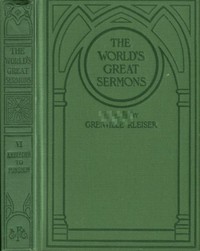
The World's Great Sermons, Volume 06: H. W. Beecher to Punshon — Context and Discussion can be approached with a clearer sense of reading commitment from its source measurements: 57,756 words, 4 hr 12 min estimated reading time, and 6 detected text sections.
The text analysis averages about 24.2 words per sentence, while the detected sections provide another way to judge how the source is divided.
Project Gutenberg metadata also associates the work with “Sermons,” connecting these edition facts with the source record’s subject description.
Explore this collection
These alternatives are selected using recorded categories and estimated reading time.
About 251 minutes
Theology
57,549 recorded words. 1 minutes difference from this book's estimate.
View Gutenberg source #44053About 253 minutes
Theology
58,144 recorded words. 1 minutes difference from this book's estimate.
View Gutenberg source #44441About 251 minutes
Theology
57,519 recorded words. 1 minutes difference from this book's estimate.
View Gutenberg source #44450Search stored excerpts and compare books → Choose by your preferences →
Choices use stored catalog measurements. Estimates vary with reading speed. A shared category is a catalog label, not a claim that two books have the same argument or literary quality.
Search reads excerpt text stored with this catalog and links to its associated Gutenberg record. The connection is stored in the site database; this tool does not recheck that every excerpt is word-for-word identical to that external record. Excerpt search does not cover every chapter and does not verify historical publication dates.
Catalog snapshot checked: 2026-09-26. Coverage: 94 public books, 94 available source excerpts.
Calculated from edition completeness, EPUB availability, text structure and catalogue metadata. Not a user rating.
Total of 100 points, scaled to a 2.5-5.0 range. Editions with an empty description or a missing EPUB file are not scored.
Public-domain source text
The source text is kept in the dedicated reader, separate from this catalogue record and its commentary.
The volume opens with Henry Ward Beecher's sermon on immortality, which immediately establishes a biographical reading of Paul's words. Beecher insists the text is not a universal principle but a personal declaration, grounding his interpretation in Paul's sacrifices. This sets a pattern: each sermon in the collection is preceded by a biographical note that primes the reader to connect the preacher's life to his message. The excerpts show that these notes are not mere formalities—they shape how the sermons are encountered.
The biographical notes are consistently placed before each sermon, and they often highlight traits that echo in the text. Beecher's note emphasizes his vocal training and dramatic power; his sermon then employs vivid, personal language. Robertson's note mentions his profound Bible research; his sermon on the loneliness of Christ is densely scriptural and introspective. Hitchcock's note calls him an "evangelical transcendentalist"; his sermon on eternal atonement engages in textual criticism. This framing encourages readers to consider how the preacher's life and character inform his theology.
The excerpts display distinct rhetorical approaches. Beecher uses a conversational, almost intimate tone: "This is not the declaration of a universal principle: it is biographical and personal." Robertson employs a more philosophical, questioning style, exploring the inner life of Christ. Hitchcock, by contrast, opens with a scholarly dispute over translation, presenting rival renderings of Revelation 13:8. These differences suggest that the collection showcases not just theological content but also the art of persuasion in the pulpit.
Each preacher anchors his argument in a specific biblical text, but they use scripture differently. Beecher takes a single verse and expands it biographically. Robertson weaves multiple allusions, such as Samuel's selection of David, to illustrate discernment. Hitchcock dissects a single verse's translation to support his thesis that atonement is eternal. This variety demonstrates how the same authoritative source can be mobilized for personal, devotional, or scholarly ends.
Despite different topics, certain motifs recur. Robertson dwells on Christ's loneliness and the believer's potential isolation: "The day may come when all that is human, man and woman, will fall off from you." Beecher emphasizes the cost of faith—Paul's exile and misery. Hitchcock focuses on eternal security, the "Lamb slain from the foundation of the world." Together, these excerpts suggest a shared concern with the individual's relationship to God amid doubt or opposition.
Readers approaching this volume should attend to the interplay between the biographical notes and the sermons themselves. The notes are not neutral introductions; they shape expectations and highlight certain aspects of the preacher's character. Noticing how each sermon opens—whether with a personal claim, a textual problem, or a philosophical reflection—can reveal the preacher's strategy for engaging his audience. The collection rewards attention to both content and form.
There’s a particular hush in these old sermons, the way Beecher turns a phrase like a key in a familiar lock. It reminded me of another quiet volume I keep nearby, The Potter and the Clay — A Reader’s Guide, which holds a similar reverence for the shaping of a life. Both feel less like arguments and more like someone thinking aloud, slowly, in the late afternoon.
Your answers remain private and are stored only in this browser.