About 251 minutes
Sermons: Selected from the Papers of the Late Rev. Clement Bailhache — Themes and Context
Theology
57,549 recorded words. 0 minutes difference from this book's estimate.
View Gutenberg source #44053
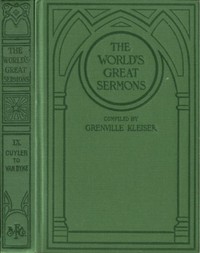
The World's Great Sermons, Volume 09: Cuyler to Van Dyke — Reading Companion can be approached with a clearer sense of reading commitment from its source measurements: 57,519 words, 4 hr 11 min estimated reading time, and 6 detected text sections.
The text analysis averages about 22.2 words per sentence, while the detected sections provide another way to judge how the source is divided.
Project Gutenberg metadata also associates the work with “Sermons,” connecting these edition facts with the source record’s subject description.
Explore this collection
These alternatives are selected using recorded categories and estimated reading time.
About 251 minutes
Theology
57,549 recorded words. 0 minutes difference from this book's estimate.
View Gutenberg source #44053About 252 minutes
Theology
57,756 recorded words. 1 minutes difference from this book's estimate.
View Gutenberg source #44439About 253 minutes
Theology
58,144 recorded words. 2 minutes difference from this book's estimate.
View Gutenberg source #44441Search stored excerpts and compare books → Choose by your preferences →
Choices use stored catalog measurements. Estimates vary with reading speed. A shared category is a catalog label, not a claim that two books have the same argument or literary quality.
Search reads excerpt text stored with this catalog and links to its associated Gutenberg record. The connection is stored in the site database; this tool does not recheck that every excerpt is word-for-word identical to that external record. Excerpt search does not cover every chapter and does not verify historical publication dates.
Catalog snapshot checked: 2026-09-26. Coverage: 94 public books, 94 available source excerpts.
Calculated from edition completeness, EPUB availability, text structure and catalogue metadata. Not a user rating.
Total of 100 points, scaled to a 2.5-5.0 range. Editions with an empty description or a missing EPUB file are not scored.
Public-domain source text
The source text is kept in the dedicated reader, separate from this catalogue record and its commentary.
The ten sermons in this volume, drawn from preachers active between the 1850s and early 1900s, display a striking range of rhetorical strategies. Theodore L. Cuyler opens with a blunt contrast between human origins: one theory brings man 'upward from the brute,' the other 'downward from God.' He dismisses evolution with a citation of Virchow, then anchors his argument in Job. Later, Robert F. Horton (not in excerpts) and others adopt more meditative tones. The collection thus becomes a study in how different voices address similar theological concerns—life, death, faith—with varying degrees of confrontation, consolation, and logical structure.
Cuyler's sermon 'The Value of Life' opens with a declarative sentence that sets the tone: 'There are two conflicting theories, nowadays, as to the origin of man.' He immediately positions himself against evolution, calling it unproven. His language is plain and forceful, using short sentences and rhetorical questions: 'Why need you and I seek to disprove what no man has ever yet proved or will prove?' This directness, combined with a clear binary (brute vs. God), creates a sense of urgency. Cuyler also employs vivid imagery—'the valley of the shadow of death,' 'the lights of the celestial city'—to evoke an emotional response. His pacing is swift, moving from refutation to affirmation within a few paragraphs.
In contrast, Francis L. Patton's 'Glorification Through Death' adopts a more analytical tone. He uses the metaphor of a corn of wheat falling into the earth to illustrate death as a necessary prelude to fruitfulness. His argument unfolds in stages: first, the principle illustrated in Judaism, then in Christ. Patton's sentences are longer and more complex, with clauses that build logical connections: 'The purpose of it was to disseminate the knowledge of the one living and true God.' He also introduces the concept of 'the perils of survivorship,' describing old age as a 'monumental intrusion into the present.' This philosophical reflection on the solitude of longevity adds a layer of psychological insight not present in Cuyler's more urgent style.
The volume's sermons differ markedly in pacing. Cuyler's opening is rapid and confrontational; Patton's is measured and reflective. Other preachers, such as Henry van Dyke in 'The Meaning of Manhood,' likely employ a more lyrical cadence (though not excerpted here). The biographical notes preceding each sermon also affect the reading experience, providing context that shapes expectations. For instance, Cuyler's note mentions his prolific writing—'some four thousand articles'—which may explain his direct, journalistic style. The collection thus offers a spectrum of homiletic voices, from the hortatory to the philosophical, each with its own rhythm and rhetorical devices.
Readers interested in the evolution of sermon rhetoric will find this volume a useful cross-section. Pay attention to how each preacher handles transitions—Cuyler's abrupt shifts versus Patton's gradual unfolding—and how they balance scriptural citation with contemporary reference. The biographical notes, though brief, hint at each speaker's background and may illuminate their stylistic choices.
Reading these sermons, I recalled my grandfather’s worn volumes, the paper soft as cloth. His favorite was Wesley’s, and I found the same patient insistence on grace there as in Van Dyke’s quiet assurance—both felt like hearing someone breathe steady beside you. The works of the Rev. John Wesley, Vol. 09 (of 32) — Inside the Classic carried that same unhurried warmth, a familiar voice across the decades.
Create a short personal record of your experience with this book.