About 253 minutes
The World's Great Sermons, Volume 07: Hale to Farrar — Text and Context
Theology
58,144 recorded words. 1 minutes difference from this book's estimate.
View Gutenberg source #44441
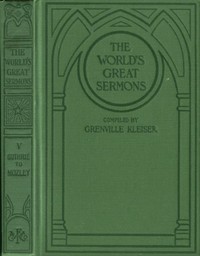
The catalog record for The World's Great Sermons, Volume 05: Guthrie to Mozley — Reading Companion provides practical reading context through 58,259 words, 4 hr 14 min estimated reading time, and 6 detected text sections.
The text analysis averages about 26.0 words per sentence, while the detected sections provide another way to judge how the source is divided.
Project Gutenberg metadata also associates the work with “Sermons,” connecting these edition facts with the source record’s subject description.
Explore this collection
These alternatives are selected using recorded categories and estimated reading time.
About 253 minutes
Theology
58,144 recorded words. 1 minutes difference from this book's estimate.
View Gutenberg source #44441About 252 minutes
Theology
57,756 recorded words. 2 minutes difference from this book's estimate.
View Gutenberg source #44439About 251 minutes
Theology
57,549 recorded words. 3 minutes difference from this book's estimate.
View Gutenberg source #44053Search stored excerpts and compare books → Choose by your preferences →
Choices use stored catalog measurements. Estimates vary with reading speed. A shared category is a catalog label, not a claim that two books have the same argument or literary quality.
Search reads excerpt text stored with this catalog and links to its associated Gutenberg record. The connection is stored in the site database; this tool does not recheck that every excerpt is word-for-word identical to that external record. Excerpt search does not cover every chapter and does not verify historical publication dates.
Catalog snapshot checked: 2026-09-26. Coverage: 94 public books, 94 available source excerpts.
Calculated from edition completeness, EPUB availability, text structure and catalogue metadata. Not a user rating.
Total of 100 points, scaled to a 2.5-5.0 range. Editions with an empty description or a missing EPUB file are not scored.
Public-domain source text
The source text is kept in the dedicated reader, separate from this catalogue record and its commentary.
Thomas Guthrie's sermon "The New Heart" opens with a mechanical metaphor: "As in a machine where the parts all fit each other, and, bathed in oil, move without din or discord." This image of harmonious operation immediately establishes his method—he will build a logical, interconnected argument from Ezekiel's promise of a new heart. The excerpt shows Guthrie's characteristic vividness, describing the temple veil torn "from top to bottom" and the priest dropping his knife as the lamb goes free. Readers should note how he uses concrete, sensory details to make theological points tangible.
Guthrie's excerpt reveals a preacher who thinks in pictures. The temple scene is rendered with cinematic precision: the outer court full, the priest in vestments, the sacrificial knife raised. He then pivots to the unseen hand tearing the veil, creating a dramatic reversal. This is not mere ornament; each image serves his argument that Christ's sacrifice ends the old system. Notice how he repeats the phrase "an end to all" to hammer home the point. The logic is cumulative: the harmony of the machine, the tearing of the veil, the cry of dereliction—all build toward the final declaration "It is finished." Readers should watch for this pattern of concrete illustration followed by doctrinal conclusion throughout the volume.
F.D. Maurice's sermon "The Valley of Dry Bones" takes its cue from Ezekiel 37. The excerpt is not included here, but the title and placement suggest a structural approach: Maurice likely uses the prophet's vision as a framework for discussing spiritual renewal. Given Guthrie's preceding sermon on the new heart, Maurice may be extending the metaphor of transformation from individual to national or ecclesiastical revival. Readers should compare how each preacher handles the same biblical book—Guthrie focuses on the promise of a new heart (Ezekiel 36), while Maurice turns to the vision of dry bones (Ezekiel 37). This juxtaposition within the volume invites reflection on different homiletical strategies for similar themes.
James Martineau's "Parting Words" appears third in the collection. The title suggests a valedictory or farewell discourse, which would mark a tonal shift from Guthrie's dramatic urgency and Maurice's prophetic vision. Martineau, a Unitarian, may offer a more philosophical or reflective approach. Readers should attend to how the volume sequences sermons: after two evangelical addresses, a more meditative piece provides contrast. The editorial arrangement by Kleiser seems designed to showcase variety in style and theology within the 19th-century British pulpit. Martineau's excerpt, if available, would likely show a different rhetorical register—perhaps more restrained, with emphasis on moral or spiritual counsel rather than apocalyptic imagery.
The final sermon, J.B. Mozley's "The Reversal of Human Judgment," likely provides a thematic capstone. The title implies a critique of worldly verdicts and an assertion of divine justice. Mozley, a prominent Anglican theologian, probably argues that human judgments are provisional and often mistaken, awaiting eschatological correction. This sermon may echo themes from earlier ones—Guthrie's new heart, Maurice's dry bones—by suggesting that true transformation requires a reversal of perspective. Readers should note how Mozley handles the tension between present experience and future hope. The volume thus moves from individual renewal (Guthrie) through corporate revival (Maurice) to a final reorientation of values (Mozley).
This volume rewards readers who attend to the interplay between sermons. Guthrie's opening sets a high bar for vividness; Maurice and Martineau offer different keys; Mozley closes with a call to reconsider human certainties. The excerpts are incomplete, so inferences about full arguments are limited, but the editorial selection clearly aims to demonstrate range within a tradition. A first reading might profitably compare how each preacher uses Scripture, illustration, and rhetorical structure to engage listeners.
Reading through Guthrie and Mozley, I kept thinking about how sermons circle a single truth from every angle. It reminded me of something quieter—how doubt and faith can hold hands in the same breath, like in A handbook of Freethought — Context and Discussion. That book lingered with me differently, less about answers, more about the asking itself.
Build a private reading journal entry for this title.